Posts

Showing posts with the label data-driven

Featured Post

Dr. Jamie Courter is your Mizzou Beef Genetics Extension Specialist

Image
By Jared E. Decker Many of you have probably noticed that things have been a lot less active on the A Steak in Genomics™   blog, but you probably haven't known why. In January 2021, I was named the Wurdack Chair in Animal Genomics at Mizzou, and I now focus on research, with a little bit of teaching. I no longer have an extension appointment. But, with exciting news, the blog is about to become a lot more active! Jamie Courter began as the new MU Extension state beef genetics specialist in the Division of Animal Sciences on September 1, 2023. I have known Jamie for several years, meeting her at BIF when she was a Masters student. I have been impressed by Jamie in my interactions with her since that time.  Dr. Courter and I have been working closely together the last 6 weeks, and I am excited to work together to serve the beef industry for years to come! Jamie holds a bachelor’s degree in animal science from North Carolina State University and earned a master's degree in animal...

Herefords in the Cove: Measure What is Important to You

Image
 As I no longer have an extension appointment, my presentations at producer meetings have become much less frequent. I did get the opportunity to present at Herefords at the Cove event put on by the Georgia Hereford Association. This is a continuation of the Herefords on the Mountain event started by Tommy Coley. Here is a link to my slides. Decker_HerefordsCove_2022.pptx As I was driving home from Junior National Hereford Expo, a thought popped into my head. I like Love's gas stations. Part of the reason I like them, is they consistently have clean bathrooms. And why do they have clean bathrooms? Because they measure it! As cattle breeders, we can take a lesson from this. We need to make sure we are measuring what is important to us and our customers.

EPDs and Genomics: A Conversation with the American Angus Association Board

Image
At the National Western Stock Show, I had a great discussion with the American Angus Association board and members. Angus Media put together a nice summary of that presentation.

Selection Decisions

Use Information Extracted from Data to Breed a Better Calf Crop and Cow Herd Here is a fun conversation starter on your next visit to the coffee shop or diner. What is the most important trait in cattle production? What trait do you think is most important? Another way to ask this question, how do you define a "good" cow? In a typical group of cattle producers, you will get a lot of different answers. One person will say weaning weight and another will say marbling. A third may say calving ease, "Gotta have a live calf." A fourth may say fertility. But, why are these different traits important? Because they affect the profitability of beef operations! Profit is the most important trait in beef production. The profitability of a bull's or cow's calves should be our number one criterion when selecting breeding stock.  How many beef producers go to a bull sale to buy a load of soil or a bag of feed? In other words, do we go to a bull sale to buy the environmen...

Show-Me Ag: Beef Genetics and the Environment

Image
Are cattle responsible for 51% of greenhouse gas emissions? How can technology help? Head over to the Show-Me Ag website to see Jared Decker discuss beef cattle, the environment and genetics. https://www.kmos.org/ShowMeAg/ Episode from December 12, 2019 (2019/12/12, titled "Cattle Genetics").

Red Angus Seeking Input on Selection Indexes

The Red Angus Association of America is seeking feedback on their economic selection indexes. Producers can provide feedback at this link: https://www.surveygizmo.com/s3/5183855/RedAngusAssociation?fbclid=IwAR3qskT1DJ6UMbSIS2R3ul316FQ6L_k-Gt_DYDq8wB8omLQOgkG1yCuAGbM To be frank, I am conflicted by this process. On one hand, I think it is important to have translational research be a collaborative process. Further, users are more likely to trust and use a technology if they were involved in its creation. However, often times, optimal selection decisions are counterintuitive  (need to write a blog post on this). I feel strongly that selection decisions are best made when driven by data, and that includes design of selection tools. American Angus Association went through a similar process, and it is my understanding they used the survey data to weight economic importance of traits that are hard to pin down, such as claw set and docility. Traits that are economically important,...

Selection for Improved Carcass in Red Angus

Image
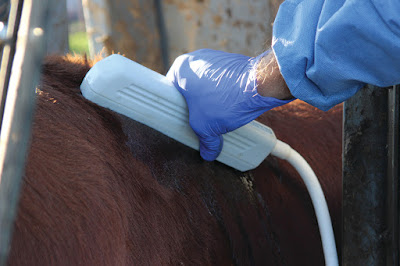
by Ryan Boldt, Director of Breed Improvement, RAAA Selection for carcass trait performance is important to keep in mind when making bull-purchasing decisions. Most carcass traits are moderately heritable in nature. In seedstock animals, the best method to collect information about carcass-trait performance is through the use of ultrasound imagining. Generally, ultrasound information is collected on seedstock animals at a year of age. When an ultrasound is collected, up to four measurements are taken. The most common measurements recorded include intramuscular fat, backfat, and rib eye area which serves as the best indicators for carcass marbling score, carcass back fat and carcass ribeye area. The ultrasound information is collected via a probe that emits high-frequency sound waves. The probe is placed on the animals back and an image is created that shows the difference between different tissues under the animal’s hide. These images are captured by a certified ultrasound techn...

BIF 2019: The use of 'Big Data' in a modern swine breeding program now and in the future

Jeremy Howard Smithfield Premium Genetics  Smithfield Premium Genetics is the nucleus that provides sows (over 1 million) for Smithfield and the sires of the terminal market pigs. At Smithfield, they mate a Landrace to a Large White to produce the commercial F1 sow. These sows are then breed to a Duroc. The terminal pig then has maximal heterosis (maternal heterosis and direct heterosis). SPG uses single sire semen of Durocs to mate to commerical farms in Missouri and North Carolina. They collect 60,000 carcass data points per year. On the maternal side, it is had to get stayability data because generations are turned over so quickly. They use commercial test herds to collect this data on sows. Howard said that genomic information on purebred animals prior to selection allows them to better predict performance in a commercial setting. This genomic data also allows them to figure out if problematic meat is produced at a company owned farm or an outside source. Big data is dri...

BIF 2019:The Latest Agri-Tech Emerging in the Australian Grazing Industries

Mark Trotter Central Queensland University His research is outcome, not technology driven. It is not finding shiny new tools and asking how can I use it. Rather, it is looking at problems in the industry and finding solutions, including technology, to help it. Northern Australia is much more similar to central America that it is to the United States. Southern Australia is similar to the southern US. There are several tools for stocking rate management, but there is a need to get good tools into these systems. There is now high spatial and temporal satellite data  that is now basically available for free. There are emerging radar satellite systems. There's a lot of hype around "smart tags" and other agtech, but what's the actual need and value? There are three key bits of information producers would love to have from a sensor system: Location Behavior Health Producers see lots of applications for smart tags. Location We went from big backpacks on ca...

BIF 2018: How Does the Dairy Industry Handle Information?

Chuck Sattler Vice President, Genetic Programs, Select Sires Inc. Data is fuel for breed improvement programs. Data drives the machine. Noise in the data is like water in the fuel. Data has value! However, individual records have very little data. We have to share data for it to achieve its value. "We are not good at investing in data. It's not sexy," Sattler said. We need to invest in data collection. We need to share data thoughtfully. Have a written agreement and think strategically when sharing data. Genomic evaluations are a big data success story! "We marvel at the technology that makes this all possible," he said. As much as it is a story about DNA technology, it is also a story about bring large amounts of data together. It is also a success of big data. If we had to do it over again, dairy industry might re-think Dairy Recording Processing Centers. Dairy Recording Processing Centers control the data and sometimes the breeder's voice is no...

Cattle Raisers Convention 2018: Bull Selection Panel

Moderator: Tommy Perkins, International Brangus Breeders Association Panelists:   Kelley Sullivan, Santa Rosa Ranch Donnell Brown, RA Brown Ranch What DNA tests do you require when you buy a bull? Parentage? Genetic Defects? Polled? Coat Color? What trait is most important in bull selection? Does genomic testing provide value? Donnell Brown currently markets 4 different breeds (Angus, Red Angus, SimAngus and a 4-breed composite called Hotlander ™ ). Brown has been involved with 17 different breeds. They DNA parentage test every animal born on their place. Five to ten percent of animals have the wrong parentage assigned. Cows swap calves. The wrong straw gets pulled out of the tank. A bull comes over from two pastures over and then goes home before we ever knew he was out. Would we prefer to use a bull with one calf crop or a bull with no calves? Most producers prefer the bull with more data. Genomic-enhanced EPDs provide the same amount of information as the first calf cr...

Angus Genetics Inc Releases Foot Score Research EPDs

Image
In January, Angus Genetics, Inc. (AGI) announced the release of research Claw Set and Foot Angle EPDs. The development of a research EPD is the second step towards a production EPD. This followed research presented in the summer of 2017 which found heritabilities of 0.34 for foot angle and 0.21 for claw set. Estimating heritability (portion of the trait influenced by genetics) is the first step towards a production EPD. This research also found a genetic correlation of 0.22 between the two traits, indicating that both traits need to be reported and analyzed. Stephen Miller, AGI Director of Genetic Research stated, "“Angus breeders have completed a tremendous amount of data reporting in such a short period of time; this is truly a testament to their commitment toward genetic progress. We are absolutely thrilled to begin the process of rolling this breakthrough out to the membership.” Kelli Retallick, AGI Director of Genetic Services cautioned, “Though we are getting closer ...

Do You Own Your Job or a Business? Are You Working for a Lunatic?

Image
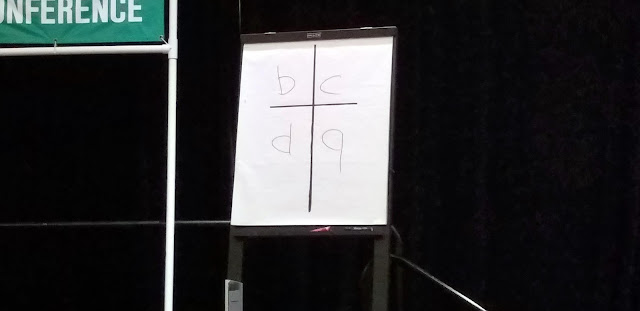
David Pratt Presentation at  Southwest Missouri Spring Forage Conference  Ranch Management Consultants Inc. runs two programs, The Ranching For Profit School and the Executive Link . "When we work for ourselves, we work at what we are good at." Pratt says. We are doing the $10 an hour job. However, we may be leaving the $100,000 per hour job undone. Most ranches are likely losing money. Pratt encourages the audience to subscribe to the Ranching for Profit blog. What letter is most different? b? c? d? q? Look again: What about the t? We see things through the lens of our expectations. What if the t is a threat? What if you didn't even see it? What if the t is an opportunity? It is a lot easier to see threats and opportunities at your neighbor's operation. Too often, we wait till we are out of time and money to make changes. We hear the phrase, "If you always do what you have always done you will always get what you've always got....

Every Tool on the Belt

Written by Jackson Barry. Canton, MO, Canton FFA, Shamrock 4-H in Clark County To me, being a beef breeder in the 21st century means using every tool on the belt of the cattle industry. The goal? Produce the highest quality, most efficient cattle. Genetics is our biggest asset, because even the best management cannot overcome inferior quality. I will elaborate on the many potentials for higher production and profit through better genetics, record keeping, use of technology, and effective management. First, genetics. We can and will select those cattle who produce the most for the least. To be more specific, instead of looking at output per cow, we must look at output per unit of land, as in pounds of beef that make it to the rail compared with acres used. The fact is, a larger cow will often produce more than her smaller contemporary. However, if we step back and see the big picture, we can run more moderate sized cattle on a given pasture than larger cows. Also, it has been prove...

Reverend Bayes and Cattle Breeding

Image
Reverend Bayes via Wikimedia Commons You are asking yourself, who is Reverend Bayes and what does he have to do with cattle? The answer to this question will answer a major misconception in cattle genetics. Reverend Bayes was an 18th century Presbyterian minister. He was also trained in logic. Due to Bayes’ work on probabilities, an approach to statistics called Bayesian statistics is named after him. In Bayesian statistics, we start with a prior belief (prior probability). As more information and data are gathered, we update this prior belief. We call this new update a posterior belief. We continue this process as we collect additional data. Further, a key tenant of Bayesian statistics is evaluating the methods (i.e. models) used in our analysis. Statisticians and scientists did not frequently use this system of statistics in the early 20th century. But, with increased computing power, Bayesian statistics has become very popular in the 21st century. By Lutz Koch CC BY-NC-ND...

Thompson Research Center Field Day Announced

Image
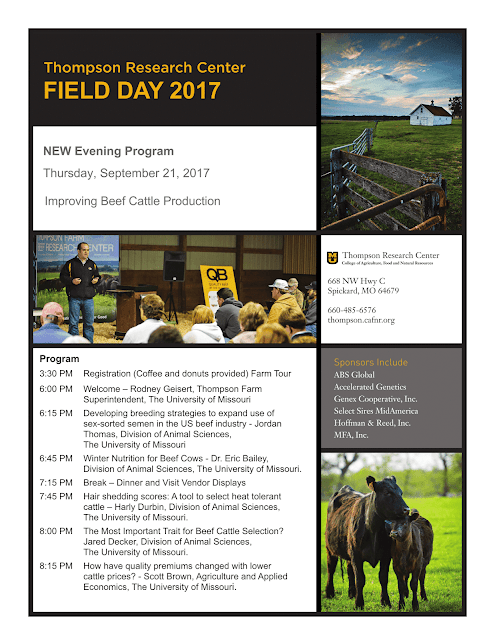
The Thompson Research Field Day will be Thursday, September 21, 2017. This year we will be having an evening program, hopefully to better accommodate more people's schedules. See the flyer below for program details. Dinner will be provided.

Angus Single-Step Has Launch Date

Angus Genetics Inc will switch to single-step genomic prediction on July 7th. Since 2010 they have been using multi-step genomic prediction. In multi-step, genomic predictions are treated as correlated traits to produce GE-EPDs. In single-step, all genomic, pedigree, and performance data is analyzed in one model. The key to calculating EPDs is measuring genetic similarity. Traditional EPDs used pedigree data to estimate genetic similarity. In single-step, genomic data more accurately measures relatedness, i.e. genetic similarity. The pedigree and genomic relationship measures are combined. Since November, AGI has evaluated multi-step vs single-step. They have seen very similar accuracies between the two methods. But, single-step tends to have slightly higher accuracies. Further, there are several advantages to single-step. These advantages include removing the need to recalibrate and using all of the data simultaneously. Watch for further information from Angus about the switch t...

Now HIRING! Looking for talented postdoctoral fellow

My group is currently recruiting a postdoctoral fellow. We are looking for candidates who are passionate about genetics, genomics, and research. Ideal candidates are creative, hard working (while maintaining a work/life balance), and self starters. Our group is strictly computational, so candidates should enjoy working on computers and analyzing data. Candidates should have programming experience (typically in R, Python, Perl, Julia, etc.) and be familiar  with the command line. Candidates will need to demonstrate  ability to write well and publish research. We currently have access to over 48,000 genotyped beef cattle with phenotypes and breeding values from breed associations (see Decker, 2015 ). We are currently negotiating to obtain access to an additional 300,000 genotyped cattle. These samples are in addition to tens of thousands of animals genotyped by the University of Missouri researchers (see Google Scholar profile for examples of data sets). We also have access...

Spring 2017 Decker Extension Evaluation Survey

I am conducting a follow up serve to the one completed last fall. I would sincerely appreciate if you would take a few minutes to complete the survey below: Decker Extension Evaluation Spring 2017 All responses are anonymous. The survey will be open till Thursday April 20, 2017. Please one survey per person. Don't hesitate to contact me with questions or concerns.

2017 Cattle Raisers Convention: Making the Cow Herd More Efficient by 2037

Dr. Clay Mathias King Ranch Institute After adjusting for inflation, there was an 18% increase in calf value from 1990 to 2015. The big cost categories are Depreciation, Feed, and Labor. The drivers of these are corn, oil, ag land and minimum wage. Corn cost increased 24%. Oil increased 284%. Ag land increased by 134%. Labor only increased by 9%. "Like calf prices, all of these increased more than inflation." Mathias said. We have seen a 30 to 50 lb increase in weaning weight over the past 20 years in the seedstock sector. We have data-driven tools for selection decisions such as genomic-enhanced EPDs. In Texas, New Mexico, and Oklahoma: Pregnancy rate from 1993 to 1995 was 89%. In 2013 to 2015 it was 90%. Weaning rate from 1993 to 1995 was 84%. In 2013 to 2015 it was 84%. Weaning weight from 1993 to 1995 was 525 lbs. In 2013 to 2015 it was 525 lbs. Pounds of calf weaned/cow exposed was 439 lbs. It was 438 lbs. in 2013 to 2015. Identical trends are see...

Beefmaster Breeders United Convention: EPDs and Selection Indexes

Image
Matt Spangler University of Nebraska-Lincoln In the past, the only way we made improvement was through visual appraisal. Photo from Harlan Ritchie's Beef Review. Difference between 1835 and 1937 champion. As the picture above shows, we can make a change, but how many of us want to wait 100 years? Improvement can be accomplished through management and genetics. In the past we (animal breeding scientist) have probably done a disservice to the industry by producing lots of EPDs, then dumping those in beef producers lap and then expect you all to make meaningful decisions with them. In some situations, this may be as valuable as a free cat. There are many factors that can influence an animals record, for example a weaning weight. Weaning weight may be affected by age of the calf, age of the dam, how much it was feed, and other environmental factors. So, we need to compare animals to their contemporaries, Contemporaries are animals of the same sex, raised at the same ra...