Posts

Showing posts with the label genomic predictions

Featured Post

Dr. Jamie Courter is your Mizzou Beef Genetics Extension Specialist

Image
By Jared E. Decker Many of you have probably noticed that things have been a lot less active on the A Steak in Genomics™   blog, but you probably haven't known why. In January 2021, I was named the Wurdack Chair in Animal Genomics at Mizzou, and I now focus on research, with a little bit of teaching. I no longer have an extension appointment. But, with exciting news, the blog is about to become a lot more active! Jamie Courter began as the new MU Extension state beef genetics specialist in the Division of Animal Sciences on September 1, 2023. I have known Jamie for several years, meeting her at BIF when she was a Masters student. I have been impressed by Jamie in my interactions with her since that time.  Dr. Courter and I have been working closely together the last 6 weeks, and I am excited to work together to serve the beef industry for years to come! Jamie holds a bachelor’s degree in animal science from North Carolina State University and earned a master's degree in animal...

Hair Shedding Research Available

Image
 Happy to submit our Hair Shedding manuscript for publication. Preprint is available at bioRxiv   https://doi.org/10.1101/2022.12.14.520472   This is an exciting manuscript. It represents the work of many collaborators, especially farmers and ranchers. I made a lot of great friends through this project. The science is exciting. The large, multi-breed sample size worked well to identify associations and genetic interactions with hair shedding. We were also able to make accurate genomic predictions of hair shedding for multiple breeds. I also think hair shedding scores are a valuable management tool. Cows who shed late tend to have poorer nutrition or are stressed in some way.  Data has been submitted to Dryad and should be publicly available soon. Data is not published yet, but in a few weeks it will appear at this address:  https://doi.org/10.5061/dryad.ngf1vhhz4   Harly Durbin Rowan deserves the lion's share of the credit for managing this project, working...

Commercial Cattlemen's Symposium Focused on Heifer Development

DENVER - The bustling ballrooms of Kalispell, Montana, will soon be filled with innovative and forward-thinking cattlemen and women during the 69th annual National Red Angus Convention. The Commercial Cattlemen’s Symposium, hosted by the Red Angus Association of America, is sure to be a highlight of the convention and will offer beef producers the tools and knowledge they need to strengthen their operations and improve their profitability. This year’s symposium, held at the Hilton Garden Inn in Kalispell on Wednesday, Sept. 14, will feature a diverse, experienced group of speakers guaranteed to offer valuable insight to attendees. “We are thrilled to continue offering commercial cattlemen and women free educational events during the annual National Red Angus Convention. As the Commercial Marketing Team, it is always exhilarating to bring so many commercial operations – our customers – together for this event. Red Angus has always been focused on the cow, and with the release of our new...

Selection Decisions

Use Information Extracted from Data to Breed a Better Calf Crop and Cow Herd Here is a fun conversation starter on your next visit to the coffee shop or diner. What is the most important trait in cattle production? What trait do you think is most important? Another way to ask this question, how do you define a "good" cow? In a typical group of cattle producers, you will get a lot of different answers. One person will say weaning weight and another will say marbling. A third may say calving ease, "Gotta have a live calf." A fourth may say fertility. But, why are these different traits important? Because they affect the profitability of beef operations! Profit is the most important trait in beef production. The profitability of a bull's or cow's calves should be our number one criterion when selecting breeding stock.  How many beef producers go to a bull sale to buy a load of soil or a bag of feed? In other words, do we go to a bull sale to buy the environmen...

Selection for Improved Carcass in Red Angus

Image
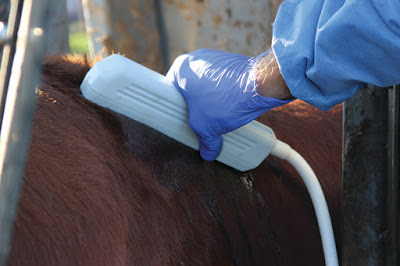
by Ryan Boldt, Director of Breed Improvement, RAAA Selection for carcass trait performance is important to keep in mind when making bull-purchasing decisions. Most carcass traits are moderately heritable in nature. In seedstock animals, the best method to collect information about carcass-trait performance is through the use of ultrasound imagining. Generally, ultrasound information is collected on seedstock animals at a year of age. When an ultrasound is collected, up to four measurements are taken. The most common measurements recorded include intramuscular fat, backfat, and rib eye area which serves as the best indicators for carcass marbling score, carcass back fat and carcass ribeye area. The ultrasound information is collected via a probe that emits high-frequency sound waves. The probe is placed on the animals back and an image is created that shows the difference between different tissues under the animal’s hide. These images are captured by a certified ultrasound techn...

Neogen partners with IGS to enhance Igenity® Beef Profile

Neogen Corporation announced September 19th, 2019 that it has entered into a collaboration with International Genetic Solutions (IGS). The effort is focused on heightening genomic impact in the IGS platform, the only major multibreed beef genetic evaluation available, and at the same time greatly enhancing the research and development necessary to continue to improve Neogen’s Igenity ® Beef Profile. The Igenity Beef Profile is a leading global genetic testing product that helps producers of both straightbred and crossbred beef commercial cattle select their best animals for breeding programs. IGS delivers the most credible, objectively described, user-friendly and science-based genetic predictions to enhance the profitability of beef cattle producers who look to leverage the full power of expected progeny differences (EPDs). “As part of this partnership, Neogen will benefit from access to information that will improve the Igenity Beef Profile, and IGS will endorse and promote ...

Mizzou Repro: Understanding the Accuracy Value of an EPD

Image
For more information, see " The Random Shuffle of Genes: Putting the E in EPD ".

BIF 2019: The Next Generation of Genetic Tools

John Genho Neogen GeneSeek Why do we use a crossbreeding system? To gain the advantage of heterosis, the cross outperforming the parent average. Retained heterosis is the amount of this advantage that is maintained after multiple generations of mating crossbreed animals (not mating the purebred parents). Dominance, over dominance, and epistasis likely all contribute to heterosis. In general, traits with higher heritabilities have lower heterosis and traits with low heritability have higher heterosis. Why don't commercial producers use crossbreeding? The average herd size is 40 head and 9% of herds have >100 head. It is harder to implement a crossbreeding program in a smaller herd. Researchers in Canada have developed genomic indicators of retained heterosis. They use the genomic data to infer the breed proportion of the animals. They can then square these breed proportions, add them up, and subtract from zero to estimate the retained heterosis. Another approach is to...

BIF 2019: Developing DNA Tests for Improved Fertility and Reduced Embryonic Loss in US Cattle Breeds

Jeremy Taylor University of Missouri Taylor is going to cover several things: GGP-F250 Imputation Haplotype diversity Embryonic Lethals The GGP-F250 is a very unique assay compared to other SNP panels. All of the other available assays (SNP panels) use common variants. The GGP-F250 has many rare variants, most of which are located in genes or other functional elements. Why is rare variation important? Most of the variation in mammalian genomes, including the genomes of cattle, contain rare variation. Most of the DNA differences between different individuals are rare variants. We can't tag this rare variation with the common variants included in most SNP panels. To accurately measure genetic differences (and predict EPDs), we have to account for rare variation. Imputation is the process of: 1. Sorting DNA variants onto each chromosome (phasing) 2. Filling in missing genotypes We can impute from 50,000 SNPs to 700,000 SNPs to 15 million variants. But, we can'...

BIF Genetic Prediction: Genetic Evaluation at the American Hereford Association

Shane Bedwell American Hereford Association Today is the 1 year plus 2 day anniversary of AHA's switch to single-step.This is the North American Hereford Genetic Evaluation including AHA and Canadian Hereford Association. They are currently working with Uruguay and Argentina are in the process of switching to the single-step approach. Part of the process was building a fully automated genomic pipeline to run the genetic evaluation weekly. They have been very happy with the quality controls measures that were built into this pipeline. AHA implemented a data pruning strategy to capitalize on their switch to whole-herd reporting in 2001. Animals that have data reported after 2001 plus 3 generations of their pedigree are included in the analysis. They have performance data on 2.3 million animals. They have genotypes on over 70,000 animals. Previously, all traits were fit in a single model. With the switch to single-step, AHA switched to 9 cluster models. They also re-paramet...

BIF Genetic Prediction: Genetic Evaluations at International Genetic Solutions

Mahdi Saatchi International Genetic Solutions IGS has data from about 15 different breed associations. They have 180,000 genotyped animals in the evaluation. Two years ago, they have 65,000 animals genotyped in IGS. Most of these were males. So, in the last two years they have almost tripled this number and have added many more females, through programs such as Cow Herd Roundup. IGS uses the BOLT software developed by Theta Solutions. This software allows many different types of models to be fit. IGS fits the single-step hybrid model. In single-step BLUP, you blend the pedigree relationships with the genomic relationship to have a single relationship matrix. In single-step hybrid you blend the genotypes and pedigree to infer genotypes for every animal in the pedigree. They then use the marker effects to estimate breeding values. In their genetic evalution they use a subset of markers that they have identified as predictive in multiple breeds. This subset of markers provides more...

BIF Genetic Prediction: Genetic Evaluation at Neogen

John Genho Neogen/GeneSeek Genho works with American breeds and smaller breed associations to provide them with genetic evaluations. He implemented single-step BLUP to use genomic information. Brangus and Santa Gertrudis have monthly genetic evaluations. Brangus has over 21,000 animals genotyped. Other clients range from 3,000 to 6,000 animals genotyped. A lot of the problems with genomic prediction is having lots of animals in the pedigree, but with relatively small proportion of animals genotyped. However, Genho works with commercial ranches who have genotyped every living animal. This simplifies many of the struggles with single-step BLUP. Genho wonders what the next iteration of models will look like given the entire dataset is genotyped. All of the American breeds have Bos indicus influence. However, there are very few pedigree connection between these breeds. Genho wonders if identifying marker effects that could be shared across breeds could be an opportunity to share ...

Show-Me-Select sales offer records on quality beef heifer replacements

Written by Duane Dailey Replacement heifers to upgrade cow-calf herds will be offered in six Show-Me-Select sales this fall. Also, owners can restock cow herds culled in the drought. With strength in beef demand and rains growing pastures, herd owners can rebuild. Dry weather’s impact on forages had farmers concerned. “Optimism of cow-calf herd owners should return,” says David Patterson, University of Missouri Extension beef specialist. “The sales can help them.” Patterson has developed Show-Me-Select for more than two decades. The marketing sales are a small part of a year-round education program. The main parts are reproduction management and genetics. This year the sales reach beyond Missouri. All will be broadcast online at LiveAuctions.TV. Buyers anywhere can bid in every sale. Sales start Nov. 16 at Joplin and Kirksville. Consignors north and south in the state offer heifers guaranteed pregnant. Many of those will be timed-AI bred, giving a calving date and uni...

University of Missouri Southwest Research Center: Expanding and Improving the Beef Herd

Image
What does it mean to have a successful cow herd in the Ozarks? What should be the genetic focus? How do we select and manage cattle to perform on toxic endophyte-infected fescue? What technologies can be used profitably? What marketing opportunities could add value to the cattle? These are questions facing every beef operation in Southwest Missouri, including the University of Missouri Southwest Research Center. As the Center moves away from a focus on grazing dairy production, faculty and staff at the Southwest Research Center and on campus at the University of Missouri recognize there is now an opportunity to increase the emphasis placed on beef cattle Research and Extension at the Southwest Research Center. With support from the Southwest Research Center Advisory Board and key stakeholders in the regional and national beef industry, an effort to expand and improve the Southwest Research Center beef herd is now underway. A Beef Focus for Southwest Missouri A defined objective ...

ARSBC 2018: Practical Application of Genomic Tests in Beef Production

Megan Rolf Kansas State University What is genomic testing? We are looking at single base changes (SNPs) at thousands of locations across an animals DNA. We can use these DNA markers to predict genetic merit differences. We can also use these DNA markers for parentage. Other DNA test don't use markers, but they directly test the variant responsible for the phenotype. Examples of this are genetic defects or coat color testing. Genotyping in seedstock We collect a DNA sample, send it off to the breed assocation, and the data is incorporated into EPDs. DNA testing for genomic-enhanced EPDs is a breed improvement strategy. It is a way to make genetic progress faster. For a seedstock producer, it also provides customer service by providing more accurate EPDs. We can used DNA to improve EPDs using two approaches. First, we can use a DNA to create a prediction of the trait and blend this prediction with the EPD. Or, we can use the DNA to better estimate the relatedness between ...

Show-Me-Select Genomic-Enhanced EPD Requirement: Where to purchase the DNA test

Image
The Show-Me-Select Replacement Heifer Program recently announced the requirement that natural service sires have genomic-enhanced EPDs . Where possible, genomic-enhanced EPDs should be available on the bull prior to purchasing him. However, this is not always the case. Some previously purchased bulls will need to be tested prior to February 1, 2020. If GE-EPDs are needed, DNA testing should be purchased and ordered through the breed association in which the bull is registered. For example, DNA testing for an Angus bull should be purchased through Angus Genetics, Inc. Do NOT purchase tests designed for commercial heifers (Igenity Beef, GeneMax Advantage, Method Genetics, etc.). Here is information on purchasing DNA testing for GE-EPDs for several common breed associations used in the program: Angus Contact AGI Customer Services at 816-383-5100 for assistance. Submitting DNA Samples to Angus Genetics Collecting DNA Samples Testing Options Red Angus Contact RAAA Nation...

Show-Me-Select Rules Require Genomic Tested Bull EPDs

Image
New sire selection rules for Show-Me-Select Replacement Heifers improve reliable calving-ease genetics. “Bulls used in the heifer program will carry DNA-tested EPDs (expected progeny differences),” said Jared Decker, University of Missouri Extension geneticist. The rules going into effect Feb. 1, 2019, were set by the SMS governing board of farmers. “DNA tests add reliability to EPDs for selecting herd bulls,” Decker said. Bulls for pasture-breeding heifers will carry genomic-enhanced EPDs. In the past, EPDs were based on pedigree and production tests. “Now GE EPDs combine DNA, pedigree and production data into a single tool,” he said. “DNA tests give results similar to 28 calving-ease production records,” Decker said. “More data boost confidence in a sire.” With DNA tests, EPDs result from checking blood drops, tissue samples or hair root bulbs. Blood or tissue tests are preferred, Decker said. A one-time test adds data on young bulls equal to years of production testing....

Show-Me-Select Board Approves Genomic Testing Requirement for Natural Service Sires

Image
All bulls purchased after February 1st, 2019 for use as natural service sires in the Show-Me-Select Replacement Heifer Program ™  must be DNA tested to have genomic-enhanced EPDs. All bulls used as natural service sires after February 1st, 2020 must have genomic-enhanced EPDs, regardless of when they were purchased. Seedstock producers classifying bulls as Show-Me-Select qualified in sale books must have genomic-enhanced EPDs on those lots. Bulls purchased prior to February 1st, 2019 will be grandfathered into the program, as is the common practice with all natural service sires. However, this grandfather grace period will end February 1st, 2020. At that time for a bull to qualify for use in the program, it must have genomic-enhanced EPDs. Why the change? The Show-Me-Select Replacement Heifer Program has the goal of producing premium heifers that perform predictably as 2 year olds. The program has a history of requiring Show-Me-Select producers to go beyond typical...

BIF 2018: Experiences with Implementation of Single-Step at American Angus, One Year In

Steve Miller Angus Genetics Inc has four research scientists. They do single-step genomic evaluations for Angus, Canadian Angus, Charolais, Canadian Charolais, and Maine-Anjou. Angus switched to single-step on July 7th, 2017. Miller feels like the switch to single-step was a monumental switch, should have made the Time Magazine year in review! When breeders see bulls re-rank, they then understand was a correlation of 0.9 really means! On July 7th, Steve Miller talked to two breeders. On July 8th he was feel cool and casual like Ferris Buller. The next week, then the calls came. "I've seen this before, in a couple of months it will all blow over" a friend told Miller. And that proved true. The switch to single-step was kind of like the stages of grief with getting a flat tire. Quiet phase: Listening, evaluating, asking yourself if you have a flat tire. Expressive phase: Cussing, kicking dirt, frustrated. Have to Move Forward phase: Fixing the tire and getting ...

Link Round Up, May 4th, 2018

Red Angus Association of America announces release of Dry Matter Intake (DMI) and Average Daily Gain (ADG) EPDs. https://www.progressivecattle.com/news/industry-news/8383-red-angus-association-releases-two-new-epds-aimed-at-increasing-efficiency Why not release a RFI EPD? The animals ranking for feed efficiency changes based on how we express the trait.  http://blog.steakgenomics.org/2014/08/improving-feed-efficiency-feed.html The best way to account for the cost of additional feed intake is through an economic selection index in which we balance both growth and intake. "Five Reasons to DNA Test Your Cows" https://hereford.org/2018/05/five-reasons-to-dna-test-your-cows/ Head over to the American Hereford Association website to learn more about DNA testing your cowherd. Speaking of DNA testing cows... Leoma Wells provided an update on the American Simmental Association's Cow Herd Roundup (CHR) on their Facebook page.  https://www.facebook.com/AmericanSimmental...

AHA Educational Session 2017: Paving the Genetic Path

Dorian Garrick Theta Solutions LLC The Theta Solutions LLC is made up of Dr. Bruce Golden, Dr. Dorian Garrick, and Dr. Daniel Garrick. They have developed the BOLT software for genetic and genomic evaluations. The American Hereford Association formed an advisory committee to check the new genetic evaluation system. The advisory committee looked at the process during development. The advisory committee included: Joe Ellis Jack Holder Lee Haygood Paul Bennett Mitch Abrahamsen Suppose we had 100 progeny (i.e. offspring) on 1 bull. You might look at that bull and decide you like him or you don’t like him. But, that bull is just an envelop that carries genetic information. What the bull looks like really doesn’t matter, what matters is what his progeny look like. The way to look at the genetic value, or breeding value, of the bull is to look at his offspring. But, there are lots of environmental effects that influence the performance of the offspring. One example is the age ...