Posts

Showing posts with the label crossbreeding

Featured Post

Dr. Jamie Courter is your Mizzou Beef Genetics Extension Specialist

Image
By Jared E. Decker Many of you have probably noticed that things have been a lot less active on the A Steak in Genomics™   blog, but you probably haven't known why. In January 2021, I was named the Wurdack Chair in Animal Genomics at Mizzou, and I now focus on research, with a little bit of teaching. I no longer have an extension appointment. But, with exciting news, the blog is about to become a lot more active! Jamie Courter began as the new MU Extension state beef genetics specialist in the Division of Animal Sciences on September 1, 2023. I have known Jamie for several years, meeting her at BIF when she was a Masters student. I have been impressed by Jamie in my interactions with her since that time.  Dr. Courter and I have been working closely together the last 6 weeks, and I am excited to work together to serve the beef industry for years to come! Jamie holds a bachelor’s degree in animal science from North Carolina State University and earned a master's degree in animal...

Breeding for a More Efficient and Profitable Commercial Cow

 Troy Rowan presented at the Kentucky Beef Efficiency Conference, January 5th, 2023. Since 1970, we are producing the same amount of beef with fewer cows. The beef industry is a plant based meat. In our selection, we often focus on the end of the year revenue. However, much of what impacts our profitability is on the cost side of the equation. If we are going to select for a single trait, that single trait has to be profitability. Which traits matter to our bottom line? We often think about things in terms of cow units. But, what really pushes our production is our forage resources. Can we make our cows more efficient at turning those forage resources into a marketable product? What does a profitable cow look like? "A profitable cow is an efficient cow," says Rowan. There are lots of different ways to be inefficient and efficient. An efficient cow is: Moderate Mature Size Maintenance Requirement Milk Fertility Longevity Structural Soundness Udder structure Emissions "The...

Selection Decisions

Use Information Extracted from Data to Breed a Better Calf Crop and Cow Herd Here is a fun conversation starter on your next visit to the coffee shop or diner. What is the most important trait in cattle production? What trait do you think is most important? Another way to ask this question, how do you define a "good" cow? In a typical group of cattle producers, you will get a lot of different answers. One person will say weaning weight and another will say marbling. A third may say calving ease, "Gotta have a live calf." A fourth may say fertility. But, why are these different traits important? Because they affect the profitability of beef operations! Profit is the most important trait in beef production. The profitability of a bull's or cow's calves should be our number one criterion when selecting breeding stock.  How many beef producers go to a bull sale to buy a load of soil or a bag of feed? In other words, do we go to a bull sale to buy the environmen...

CIC 2020: Precision Breeding and You Don't Need a GPS

Darrh Bullock University of Kentucky Precision agriculture has come to various industries. Luckily, there are already tools to do precision breeding in beef cattle. Let's talk about farm/ranch goals. For example, our goals may be to Support two families Keep workers safe Effectively use the resources we have Breeding objectives are genetically influenced objectives to help achieve farm and ranch goals. In Darrh's opinion, breeding objectives should impact the quality of life of the farm and ranch owners and workers. These objectives should improve economic, social, welfare and convenience factors of a farm. Certain traits in our breeding objective will allow us to be more efficient and have a smaller environmental impact. Other traits will be in our breeding objective simply because they make our life more convenient. Darrh pointed out that production efficiency is the key. The beef industry needs to reduce the amount of mature size and milk so that cows are mor...

BIF 2019: The Next Generation of Genetic Tools

John Genho Neogen GeneSeek Why do we use a crossbreeding system? To gain the advantage of heterosis, the cross outperforming the parent average. Retained heterosis is the amount of this advantage that is maintained after multiple generations of mating crossbreed animals (not mating the purebred parents). Dominance, over dominance, and epistasis likely all contribute to heterosis. In general, traits with higher heritabilities have lower heterosis and traits with low heritability have higher heterosis. Why don't commercial producers use crossbreeding? The average herd size is 40 head and 9% of herds have >100 head. It is harder to implement a crossbreeding program in a smaller herd. Researchers in Canada have developed genomic indicators of retained heterosis. They use the genomic data to infer the breed proportion of the animals. They can then square these breed proportions, add them up, and subtract from zero to estimate the retained heterosis. Another approach is to...

University of Missouri Southwest Research Center: Expanding and Improving the Beef Herd

Image
What does it mean to have a successful cow herd in the Ozarks? What should be the genetic focus? How do we select and manage cattle to perform on toxic endophyte-infected fescue? What technologies can be used profitably? What marketing opportunities could add value to the cattle? These are questions facing every beef operation in Southwest Missouri, including the University of Missouri Southwest Research Center. As the Center moves away from a focus on grazing dairy production, faculty and staff at the Southwest Research Center and on campus at the University of Missouri recognize there is now an opportunity to increase the emphasis placed on beef cattle Research and Extension at the Southwest Research Center. With support from the Southwest Research Center Advisory Board and key stakeholders in the regional and national beef industry, an effort to expand and improve the Southwest Research Center beef herd is now underway. A Beef Focus for Southwest Missouri A defined objective ...

Crossbreeding Considerations

Simplicity, management key to successful program  Story by Lisa Henderson Reprinted from Cattlemen' s News . Fewer open cows, less death loss, more growth, more milk and more efficiency. Those are the significant economic advantages crossbreeding can offer your cattle operation. “A crossbred cow is 25 percent more productive over her lifetime compared with a straight-bred commercial cow,” says University of Missouri animal scientist Jared Decker. “Not only do we see increased growth performance out of crossbred cattle, but we see significant impacts on fertility and reproduction.” Decker adds bluntly, “All commercial operations should consider using crossbreeding.” While the popularity of breeds can rise and fall over time, crossbreeding remains an advantageous practice for commercial herds. Heterosis, or hybrid vigor, and breed complementarity are the primary benefits realized from a properly planned crossbreeding program. Heterosis is the increase in perfo...

Cattle Raisers Convention 2018: Breed Characteristics, An Overview

Robert Wells, Noble Research Institute What breeds should you consider? Types Heterosis Complementarity effects There are two species of cattle: Bos taurus British breeds (Angus, Hereford) Continental breeds (Charolais, Simmental, Limousin, Gelbvieh, etc.) Bos indicus (Zebu, humped cattle) Brahman Nelore Gir Angus (British) Reputation is carcass and maternal. Also has a reputation for growth. "They wanted to be everything to everybody," he said. The problem with this is the increased mature size in these growthier Angus cattle. Red Angus Reputation for carcass and maternal. Before the 1950s, all Angus were Angus, regardless of coat color. The Red Angus breed has not chased growth as much as black Angus. Hereford (British) Reputation for maternal, easy fleshing, and longevity. Hereford don't typically have a lot of maintenance requirements. Shorthorn (British) Reputation as maternal and carcass. Shorthorn was previously a dual purpose breed o...

Breed composition: it’s like chocolates you can’t tell what’s inside just by looking at them

Image
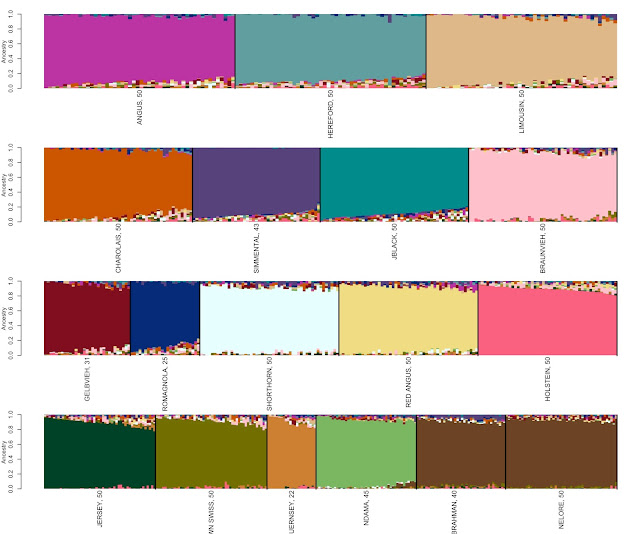
Written by  Tamar Crum, Jared E. Decker, Robert D. Schnabel, and Jeremy F. Taylor “My mom always said life was like a box of chocolates.   You never know what you’re gonna get.” – Forrest Gump You may be wondering how in the world does a box of chocolates relate to breed composition of livestock? Or, if you are anything like me, it’s where did I hide that Halloween chocolate, I need some! I think that there are two analogies between a box of chocolates and the breed composition of livestock.   First, we can pick out the white chocolates and may even be able to separate the milk chocolates from the dark chocolates.   This is similar to our ability to visually evaluate breed characteristics and sort livestock into different breed or subspecies ( Bos taurus or Bos indicus influenced) based on breed characteristics.   However, such visual evaluation of breed composition is not terribly accurate.   For example, biting into a piece of dark chocol...

Every Tool on the Belt

Written by Jackson Barry. Canton, MO, Canton FFA, Shamrock 4-H in Clark County To me, being a beef breeder in the 21st century means using every tool on the belt of the cattle industry. The goal? Produce the highest quality, most efficient cattle. Genetics is our biggest asset, because even the best management cannot overcome inferior quality. I will elaborate on the many potentials for higher production and profit through better genetics, record keeping, use of technology, and effective management. First, genetics. We can and will select those cattle who produce the most for the least. To be more specific, instead of looking at output per cow, we must look at output per unit of land, as in pounds of beef that make it to the rail compared with acres used. The fact is, a larger cow will often produce more than her smaller contemporary. However, if we step back and see the big picture, we can run more moderate sized cattle on a given pasture than larger cows. Also, it has been prove...

NCBA, Cattle Genetics Experts Team Up For 2018 Genetic Webinar Series

Image
Four sessions will help producers better utilize genetics in beef production Cattle genetics will be the focus of a new set of webinars to help cattlemen and women better use the tool in their operations.  The National Cattlemen’s Beef Association is teaming up with six genetics specialists from across the country to offer the NCBA Cattlemen’s Genetics Webinar Series, which will kick off Jan. 18, 2018. Titled “Fake News: EPDs Don’t Work,” the January webinar will be followed by sessions in February, March and April that explore other aspects of genetic utilization that will give cattle producers a knowledge boost on cattle selection and breeding. Providing expertise to producers through the webinar series is the eBEEF team, a group of six genetic specialists from five academic institutions that have invested time and resources in the advancement of the cattle industry through genetics. Members of the team are: Darrh Bullock, Ph.D., University of Kentucky; Jared Decker, Ph.D....

AHA Educational Session: Maximizing Profit

Trey Befort AHA Director of Commercial Programs Brent Lowderman Carthage Livestock, Inc. Case Gabel  Hereford Advantage Program is a genetic merit feeder cattle program which looks at the bull batteries going into commercial programs. A commercial producer using Hereford bulls sends in the registration numbers for their bull battery. The Hereford Advantage Program then shows, compared to breed average, where these bulls sit. This is used to market the calves. Lowderman In 2003, John Meents approached Lowderman about having a Hereford influenced cattle. They started with 150 head, and last year they had over 800. Calves need to have two rounds of shots. Needs to be castrated and dehorned. They then break the calves into lots based on 100 pounds increments to group them into similar lots (steers between 450 and 550 pound, between 550 and 650, etc.). Heifers are broken into lots by 75 pound breaks. The Hereford sale is within 1 to 3 dollars of the Angus ...

BIF 2017: Making the most of genetic selection in a challenging environment

John Genho Livestock Genetic Services In challenging environments, we need to use heterosis. We need cross-bred cows in these challenging environments. Deseret Ranches Deseret Ranches uses three different herds. They have a Simbrah sired cowherd, Brangus sired cowherd, and a Deseret Red sired cowherd. A Deseret Red is 3/8th Red Poll, 3/8th South Devon, and 1/4 Brahman. The Simbrah sired cows are breed by Brangus bulls, the Brangus sired cows are mated to Deseret Red bulls, and Deseret Red sired cows are mated to Simbrah bulls. King Ranch The Santa Gertrudis breed was developed at King Ranch 90 years ago. They have a seedstock Santa Gertrudis herd where they perform selection with an internal EPD system. They then have a multiplier herd where they make Red Angus x Santa Gertrudis F1 bulls. These bulls are then used in the commercial herd. Replacement females are developed from the commercial herd. They have Heifer Pregnancy EPD and Breed Back EPD from their internal EPD evaluat...

Making a Positive Genetic Impact on Your Herd: NCBA's Cattlemen's Webinar Series

Image
Technology in the beef industry is constantly improving, which can make it hard to keep up. Plus, we want to ensure that we are using all of the available practices to produce beef in a profitable, efficient, and conscientious manner. With this in mind, National Cattlemen's Beef Association hosts an annual webinar series, and this year I am excited to be involved! On February 16th at 7PM CST, Bob Weaber and I will present during the NBCA Cattlemen's Webinar Series. Dr. Weaber will discuss the positive effects crossbreeding has on your cow herd and how new research is allowing us to better understand why crossbreeding works. I will discuss where we have been and where we are going with DNA and genomic technologies. There will be a question and answer period, so please bring questions. Register today at www.beefusa.org !

Heifer Sale Exceeds Expectations

by Eldon Cole, Livestock Specialist Headquartered in Lawrence County, MO The skidding cattle market the past few months resulted in considerable pessimism prior to the 33 rd Show-Me-Select (SMS) Bred Heifer Sale at Joplin Regional Stockyards on November 20.  However, when the last of 293 heifers left the ring, the average price of $2477 brought smiles to most of the sellers. The previous 32 sales results predicted an average heifer price just under $2000 per head.  That forecast is based on the week’s average price per head for a 550 pound, Medium and Large Frame, Number 1 Muscle steer at the Joplin and Springfield markets.  That average amounted to $1011 per head according to the Missouri Market Summary. The SMS heifer average of $2477 divided by the steer average resulted in a 2.45:1 figure.  In the previous sales the highest ratio was 2.4:1.  Since the SMS sales began in 1997 at Joplin the smallest ratio was 1.65:1 in 1999. There was a s...

Use Genomics to Maximize Dairy-Beef Crossbreeding

In the March-April 2014 issue of Best of the West , there is an article about producing beef cattle by  breeding dairy cows to beef bulls . At the Midwest American Society of Animal Science meetings in Des Moines, Iowa, Kent Anderson of Zoetis discussed this practice and how genomics plays a part in selecting the animals used in these crosses. A dairy producer can use a genomic prediction test, such as Zoetis' CLARIFIDE® , to rank the cows in their herd. The producer can breed the top portion of their cows to dairy sires to produce replacement heifers. The use of sexed semen increases the efficiency of this strategy, as ~90% of these matings result in heifer pregnancies. Then the producer can breed the bottom portion of the cows to a beef sire to produce calves that will be marketed as beef feeder cattle . It is important to select beef bulls that excel at rib eye area and yield grade, as these are the main weaknesses of dairy steers. Research is underway to develop genomic EP...

Ancient African Cattle First Domesticated in Middle East, MU Study Reveals
New genetic history of cattle allows for better breeding methods, reveals new aspects of human history

Image
From PLOS Genetics doi:10.1371/journal.pgen.1004254.g005 Story Contact : Nathan Hurst,   hurstn@missouri.edu , 573-882-6217 COLUMBIA, Mo. – Geneticist and anthropologists previously suspected that ancient Africans domesticated cattle native to the African continent nearly 10,000 years ago. Now, a team of University of Missouri researchers has completed the genetic history of 134 cattle breeds from around the world. In the process of completing this history, they found that ancient domesticated African cattle originated in the “ Fertile Crescent ,” a region that covered modern day Iraq, Jordan, Syria and Israel. Lead researcher Jared Decker , an assistant professor of animal science in the MU College of Agriculture, Food and Natural Resources, says the genetics of these African cattle breeds are similar to those of cattle first domesticated in the Middle East nearly 10,000 years ago, proving that those cattle were brought to Africa as farmers migrated south. Those cattle t...

Crossbred Replacement Females Average $529 More Than Straightbred

Real-world research utilizing crossbreeding has led to documented real-world results in hybrid female demand compared to straight-bred females. During the recent Circle A Ranch Sale Oct. 19, 29 black-baldie heifers averaged $2,960, and the top-selling lot was black-baldie heifers bred with heifer-calf-confirmed pregnancies at $3,450 each. The average price paid for the 269 straight-bred Angus heifers was $2,431. That’s a crossbred advantage of $529 per head in price. In 2007 Circle A Ranch, Iberia, Mo., began a research project with the American Hereford Association (AHA) designed to determine and measure the advantages of using Hereford genetics on commercial Angus cows. Results from the project documented the Hereford efficiency advantage with a 7% increase in conception rate along with improved feed efficiency and average daily gain. Utilizing the Circle A data, economist Vern Pierce developed an economic model which projected that over a 10-year period, using Hereford bulls on An...