Posts

Featured Post

Dr. Jamie Courter is your Mizzou Beef Genetics Extension Specialist

Image
By Jared E. Decker Many of you have probably noticed that things have been a lot less active on the A Steak in Genomics™   blog, but you probably haven't known why. In January 2021, I was named the Wurdack Chair in Animal Genomics at Mizzou, and I now focus on research, with a little bit of teaching. I no longer have an extension appointment. But, with exciting news, the blog is about to become a lot more active! Jamie Courter began as the new MU Extension state beef genetics specialist in the Division of Animal Sciences on September 1, 2023. I have known Jamie for several years, meeting her at BIF when she was a Masters student. I have been impressed by Jamie in my interactions with her since that time.  Dr. Courter and I have been working closely together the last 6 weeks, and I am excited to work together to serve the beef industry for years to come! Jamie holds a bachelor’s degree in animal science from North Carolina State University and earned a master's degree in animal...
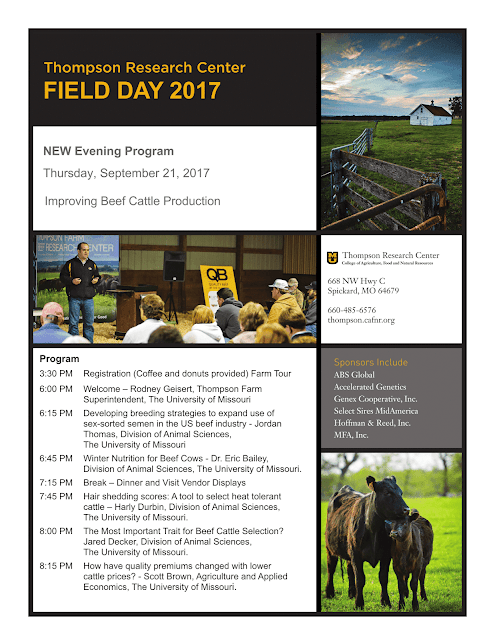
Thompson Research Center Field Day Announced

Image
The Thompson Research Field Day will be Thursday, September 21, 2017. This year we will be having an evening program, hopefully to better accommodate more people's schedules. See the flyer below for program details. Dinner will be provided.

Show-Me-Select heifer sales end with highest prices at Palmyra

PALMYRA, Mo. – The fourth and final spring Show-Me-Select heifer sale topped the average price of all at $1,928. “Buyers were light, but bidders came to buy heifers,” said Daniel Mallory, University of Missouri Extension livestock specialist, New London. He noted that many new buyers came from northern Missouri and Iowa. Consignors were mostly longtime members of the MU Show-Me-Select Replacement Heifer Program. “That shows the quality of the program,” Mallory said. “Farmers see the added value built for the past 21 years.” The Palmyra sale sold 120 heifers from 12 consignors. They went to 16 buyers. The top price was $2,550 at F&T Livestock Market, June 3. That was for a single black-baldy heifer from Richards Farm, Keytesville. She was a Tier Two, AI-bred. Price averages for the other sales: Farmington, $1,813; Fruitland, $1,764; Joplin, $1,714. Tops at the first two sales were $2,500 per head. The top at Joplin was $3,200. Those were for a new class of SMS heifers called S...

BIF 2017: Evaluating Sustained Cow Production: Alternative Definitions of Stayability

Guest post by Tamar Crum , University of Missouri Scott Speidel Colorado State University The concept of stayability was developed ~23 years ago. Stayability is simply, generally, the survivability to a certain age given the opportunity to reach that age. Multi-breed stayability analyses are difficult because of different definitions of stayability. Is the female present in the herd at 6 years old? (basic/generic definition) Did she wean a calf at 6 years old? Did she wean a calf at 6 years old while also calving at 2 years of age? Did she calve 5 consecutive times within the same calving season? Successful females for stayability varies depending on which of the definitions of stayability the breed association has adopted. It is shown that stayability to 6 years of age is a heritable trait. Stayability is a HUGE driver of herd profitability and accounts for 53-77% of the value of of the maternal indices. Currently, stayability is recorded as a binary trait. ...

BIF 2017: Field Testing $BEEF in Purebred Cattle

Guest post by Tamar Crum, University of Missouri Tom Brink Red Angus Association of America Fitting that the Georgia peach is in the logo for this year’s BIF, as we have learned throughout the conference that the industry has been provided with many types of “fruit” to choose form when it comes to our technology and genetic tools. Do EPDs work?  Are you a skeptic? If so, you are not alone! Believe it or not there are still skeptics out there. Numerous studies have been completed on carcass traits, milk, and weaning weight EPDs in the late 1990s and 2000s.  After that period, the research coming out proving EPDs worth got a little sparse.  Why? We convinced ourselves and our scientists that EPDs work, but skeptics remained in the industry.  They wanted to belief in EPDs but still need to see more. This study was in conducted in conjunction with Gardiner Angus Ranch, Zoetis, and Top Dollar Angus. The field test wanted to make comparisons between high...

BIF 2017: Making the most of genetic selection in a challenging environment

John Genho Livestock Genetic Services In challenging environments, we need to use heterosis. We need cross-bred cows in these challenging environments. Deseret Ranches Deseret Ranches uses three different herds. They have a Simbrah sired cowherd, Brangus sired cowherd, and a Deseret Red sired cowherd. A Deseret Red is 3/8th Red Poll, 3/8th South Devon, and 1/4 Brahman. The Simbrah sired cows are breed by Brangus bulls, the Brangus sired cows are mated to Deseret Red bulls, and Deseret Red sired cows are mated to Simbrah bulls. King Ranch The Santa Gertrudis breed was developed at King Ranch 90 years ago. They have a seedstock Santa Gertrudis herd where they perform selection with an internal EPD system. They then have a multiplier herd where they make Red Angus x Santa Gertrudis F1 bulls. These bulls are then used in the commercial herd. Replacement females are developed from the commercial herd. They have Heifer Pregnancy EPD and Breed Back EPD from their internal EPD evaluat...

BIF 2017: Factors affecting feedlot profitability

Gary Fike Tri County Steer Carcass Futurity Cooperative The Tri County Steer Carcass Futurity Cooperative first helps producers collect growth and carcass data. They help them benchmark their cattle related to the industry. It is hoped that this information will be used to make genetic improvement. The cooperative also works to help encourage and educate about retained ownership in the beef industry. It all comes down to profit. From an analysis of 25 states, the most profitable group make $216 per head, the least profitable group lost $120 per head. Out of 6 groups, the 4th and 5th groups basically broke even. What are the big things that drive whether or not a consignment of cattle was profitable? The least profitable group came in as the heaviest group. The most profitable cattle cost the least as feeders (bought cheap and sold high). The most profitable group had the fastest growth rates and were heaviest at slaughter. The most profitable cattle gained well during the war...

BIF 2017: Investing in the future, heifer development for longevity

Justin Rhinehart University of Tennessee A step-by-step guide for heifer development: Breed early in the first breeding season Minimize calving difficulties Wean acceptable calves Breed early in the second breeding season Optimize profit Improve genetics In our nutritional development, we can have steady growth, fast early growth then plateau, slow early growth and fast late growth. We can develop heifers to a lower target weight and still get good pregnancy weights. If we have range development vs feedlot development of heifers, we see higher pregnancy rates in the range developed heifers. The range developed heifers also stay in the herd longer. One month before breeding season, reproductive tract scores heifers and cull heifers that have not reached sexual maturity. Estrus synchronization is also a great tool for jump starting heifers using the progesterone in a CIDR. With a limited approach to heifer development, using estrus synchronization is very important...