Posts

Showing posts with the label ancestry

Featured Post

Dr. Jamie Courter is your Mizzou Beef Genetics Extension Specialist

Image
By Jared E. Decker Many of you have probably noticed that things have been a lot less active on the A Steak in Genomics™   blog, but you probably haven't known why. In January 2021, I was named the Wurdack Chair in Animal Genomics at Mizzou, and I now focus on research, with a little bit of teaching. I no longer have an extension appointment. But, with exciting news, the blog is about to become a lot more active! Jamie Courter began as the new MU Extension state beef genetics specialist in the Division of Animal Sciences on September 1, 2023. I have known Jamie for several years, meeting her at BIF when she was a Masters student. I have been impressed by Jamie in my interactions with her since that time.  Dr. Courter and I have been working closely together the last 6 weeks, and I am excited to work together to serve the beef industry for years to come! Jamie holds a bachelor’s degree in animal science from North Carolina State University and earned a master's degree in animal...
Breed composition: it’s like chocolates you can’t tell what’s inside just by looking at them

Image
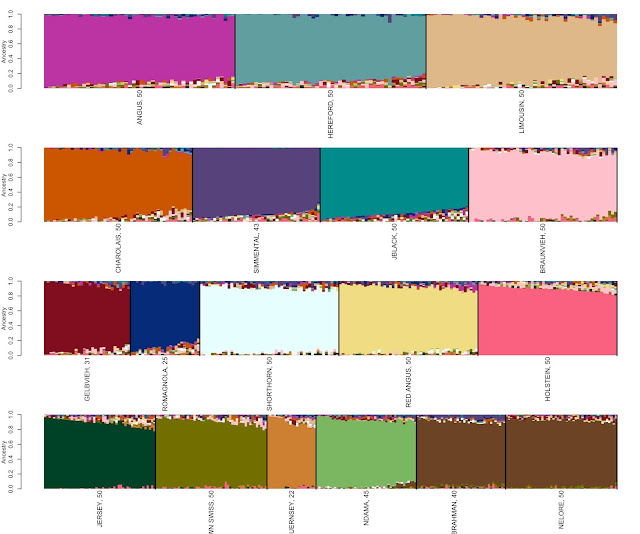
Written by  Tamar Crum, Jared E. Decker, Robert D. Schnabel, and Jeremy F. Taylor “My mom always said life was like a box of chocolates.   You never know what you’re gonna get.” – Forrest Gump You may be wondering how in the world does a box of chocolates relate to breed composition of livestock? Or, if you are anything like me, it’s where did I hide that Halloween chocolate, I need some! I think that there are two analogies between a box of chocolates and the breed composition of livestock.   First, we can pick out the white chocolates and may even be able to separate the milk chocolates from the dark chocolates.   This is similar to our ability to visually evaluate breed characteristics and sort livestock into different breed or subspecies ( Bos taurus or Bos indicus influenced) based on breed characteristics.   However, such visual evaluation of breed composition is not terribly accurate.   For example, biting into a piece of dark chocol...

Now HIRING! Looking for passionate graduate students and post doctoral fellows

My group is currently recruiting people to fill two graduate student positions. We will also be recruiting a researcher to fill a postdoctoral position in the coming year. We are looking for candidates who are passionate about genetics, genomics, and research. Ideal candidates are creative, hard working (while maintaining a work/life balance), and self starters. Our group is strictly computational, so candidates should enjoy working on computers and analyzing data. Candidates should be willing to learn programming (typically in R or Python), or already have some programming experience. We will soon have access to over 200,000 genotyped beef cattle with phenotypes and breeding values. We also have access to whole genome sequencing data from over 2,000 cattle. So, if you like working with lots of data, come join us! Our group uses population genomics to better understand the  history of cattle breeds and to inform future selection decisions. We are interested in local genetic ada...

Applying new technologies to investigate ancestry in cattle


Article from Fall 2011 "Lincoln Letter"
Newsletter of the North American Lincoln Red Assocition

Image
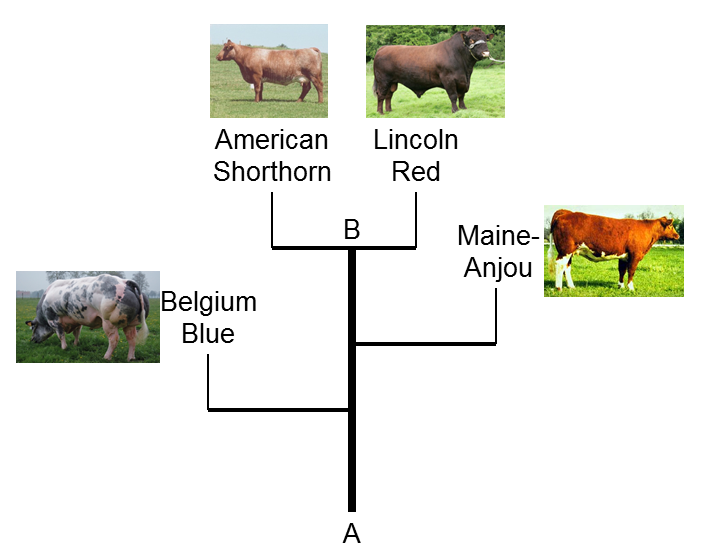
Jared E. Decker and Jeremy F. Taylor Animal breeding can be viewed from the perspective of three basic categories: recording matings, predicting the outcome of matings, and planning future matings.  Thus, ancestry is a central and integral part of animal breeding, and breeders have had an inherent interest in ancestry since at least the time of Robert Bakewell (1725-1795).  Until recently, we could only trace ancestry as far back as we had pedigree records.  But, with the advent of DNA technologies we are now able to infer the extent of relationships among individuals separated by hundreds, thousands, and even millions of years – i.e., the individuals are from different species. In 2009, we published research that describes the relationships between 48 different breeds of cattle and the relationships between cattle and other ruminant species. We used a recently developed DNA analysis kit, called the Illumina BovineSNP50 BeadChip, to survey approximately 50,000 sites ...

Ancient African Cattle First Domesticated in Middle East, MU Study Reveals
New genetic history of cattle allows for better breeding methods, reveals new aspects of human history

Image
From PLOS Genetics doi:10.1371/journal.pgen.1004254.g005 Story Contact : Nathan Hurst,   hurstn@missouri.edu , 573-882-6217 COLUMBIA, Mo. – Geneticist and anthropologists previously suspected that ancient Africans domesticated cattle native to the African continent nearly 10,000 years ago. Now, a team of University of Missouri researchers has completed the genetic history of 134 cattle breeds from around the world. In the process of completing this history, they found that ancient domesticated African cattle originated in the “ Fertile Crescent ,” a region that covered modern day Iraq, Jordan, Syria and Israel. Lead researcher Jared Decker , an assistant professor of animal science in the MU College of Agriculture, Food and Natural Resources, says the genetics of these African cattle breeds are similar to those of cattle first domesticated in the Middle East nearly 10,000 years ago, proving that those cattle were brought to Africa as farmers migrated south. Those cattle t...

My Genetic Ancestry

Image
Congratulations to Eric who only missed my percentage of Neanderthal ancestry by a tenth of a percent! I am 2.9% Neanderthal, which puts me in the in the 83rd percentile (which means I have more Neanderthal DNA than 83% of 23andMe customers). I also learned other information about my ancestry. I am basically Northern European, most of which is British and Irish. 23andMe has also identified 991 possible relatives. For a handful of these relatives I've been able to identify the ancestor that we have in common. It has also been interesting to find my risk predictions for certain diseases, my carrier status for several inherited conditions, and predictions for various traits. Unfortunately, 23andMe has runaground of FDA regulations and have stopped offering health predictions  to new customers. As someone interested in population genetics, genealogy, and genomic predictions, I have really enjoyed the information provided by 23andMe. I'm hoping that 23andMe can overcome...

Genomics, Ancestry, and a Contest!

Image
In addition to DNA variants' utility in predicting EPDs , disease risk, and other traits, they are also very useful in predicting an individual's ancestry. The most common use of this in livestock is parentage verification or testing. But DNA variants can also be used to look at relationships over much longer time scales. For example, my coauthors and I have used SNPs to look at relationships among ruminant species and breeds of cattle . Last week I sent 10 mL of my saliva to 23andMe to for processing and DNA testing. This is the human equivalent of genomic-enhanced EPDs (although 23andMe uses different statistical methods). In addition to finding out if I carry specific genetic disorders and my risk for common diseases, I will also find out about my ancestry. One of the interesting things we have learned from sequencing ancient genomes is that most humans from Europe or Asia have Neanderthal ancestry . So, as part of my 23andMe results I will learn what percent of ...