Posts

Showing posts with the label announcement

Featured Post

Dr. Jamie Courter is your Mizzou Beef Genetics Extension Specialist

Image
By Jared E. Decker Many of you have probably noticed that things have been a lot less active on the A Steak in Genomics™   blog, but you probably haven't known why. In January 2021, I was named the Wurdack Chair in Animal Genomics at Mizzou, and I now focus on research, with a little bit of teaching. I no longer have an extension appointment. But, with exciting news, the blog is about to become a lot more active! Jamie Courter began as the new MU Extension state beef genetics specialist in the Division of Animal Sciences on September 1, 2023. I have known Jamie for several years, meeting her at BIF when she was a Masters student. I have been impressed by Jamie in my interactions with her since that time.  Dr. Courter and I have been working closely together the last 6 weeks, and I am excited to work together to serve the beef industry for years to come! Jamie holds a bachelor’s degree in animal science from North Carolina State University and earned a master's degree in animal...

Show-Me-Select Board Approves Genomic Testing Requirement for Natural Service Sires

Image
All bulls purchased after February 1st, 2019 for use as natural service sires in the Show-Me-Select Replacement Heifer Program ™  must be DNA tested to have genomic-enhanced EPDs. All bulls used as natural service sires after February 1st, 2020 must have genomic-enhanced EPDs, regardless of when they were purchased. Seedstock producers classifying bulls as Show-Me-Select qualified in sale books must have genomic-enhanced EPDs on those lots. Bulls purchased prior to February 1st, 2019 will be grandfathered into the program, as is the common practice with all natural service sires. However, this grandfather grace period will end February 1st, 2020. At that time for a bull to qualify for use in the program, it must have genomic-enhanced EPDs. Why the change? The Show-Me-Select Replacement Heifer Program has the goal of producing premium heifers that perform predictably as 2 year olds. The program has a history of requiring Show-Me-Select producers to go beyond typical...

2018 ReproGene Sessions Announced

Written by Duane Dailey Beef-cow herd owners will learn new ways to raise better calves at three University of Missouri meetings in March. The sessions lead producers from proven breeding to new uses of DNA. MU Extension animal scientists David Patterson and Jared Decker will lead the ReproGene Meetings. Management of fixed-time artificial insemination allows more live calves and more uniform calf crops. New DNA tools make rapid advances in beef quality. Genomics allow breeders to predict traits of the next generation. Traditionally, breeders use expected progeny differences (EPDs). Now, new EPDs add DNA data. Pedigrees and production testing are still used; however, genetically-enhanced EPDs give more accuracy. A simple DNA test with blood or hair samples replaces years of production testing. With GE-EPDs, the added DNA speeds improving traits, whether for maternal or meat market ends. Recent high premiums at packing plants signal demand for more high-qual...

Transferring Technology: Division of Animal Sciences receives grant to develop The National Center for Applied Reproduction and Genomics (NCARG)

Image
Written by Logan Jackson College of Agriculture, Food and Natural Resources The Division of Animal Sciences at the University of Missouri College of Agriculture, Food and Natural Resources (CAFNR) boasts many strengths, including its vast research and work with beef cattle reproduction and genetics. The faculty, who have responsibilities not only in research, but also in teaching, extension and economic development, are experts in taking their findings and sharing them with farmers, ranchers and the Missouri community as a whole. With the help of a $300,000 grant from the United States Department of Agriculture (USDA), the division will be able to expand on those leadership opportunities. The grant, through USDA’s National Institute of Food and Agriculture (NIFA), will be used to develop The National Center for Applied Reproduction and Genomics (NCARG) in Beef Cattle. The goal of NCARG will be to promote the economic impact of the technologies Mizzou Animal Sciences fac...

NCBA, Cattle Genetics Experts Team Up For 2018 Genetic Webinar Series

Image
Four sessions will help producers better utilize genetics in beef production Cattle genetics will be the focus of a new set of webinars to help cattlemen and women better use the tool in their operations.  The National Cattlemen’s Beef Association is teaming up with six genetics specialists from across the country to offer the NCBA Cattlemen’s Genetics Webinar Series, which will kick off Jan. 18, 2018. Titled “Fake News: EPDs Don’t Work,” the January webinar will be followed by sessions in February, March and April that explore other aspects of genetic utilization that will give cattle producers a knowledge boost on cattle selection and breeding. Providing expertise to producers through the webinar series is the eBEEF team, a group of six genetic specialists from five academic institutions that have invested time and resources in the advancement of the cattle industry through genetics. Members of the team are: Darrh Bullock, Ph.D., University of Kentucky; Jared Decker, Ph.D....

KOMA Beef Cattle Conference in Springfield, Mo. on January 16th; Preregister by January 12th

Stockton, Mo. – The KOMA Beef Cattle Conference begins at 4 p.m., January 16, 2018, at the Springfield Livestock Marketing Center in Springfield, Mo. The KOMA (4 – State) Beef Cattle Conference is a joint effort by the Extension Services in Kansas, Oklahoma, Missouri and Arkansas.  It is designed to provide the latest information on beef cattle production, marketing, economics, nutrition and forage utilization.  Presenters and presentations at the meeting include: Dr. David Lalman, Professor – Harrington Chair Extension Beef Cattle Specialist Oklahoma State University, will be discussing “matching genetic potential to forage resources” Dr. Jared Decker, Assistant Professor of Beef Genetics Extension and Computational Genomics at the University of Missouri – Columbia, will be discussing “genetics for cow efficiency and profit” Dr. Craig Payne, University of Missouri – Columbia Associate Extension Professor Veterinary Medicine, will be discussing “current thinking...

eBEEF announces webinar series

Image
eBEEF is partnering with National Cattlemen's Beef Association to present a series of webinars in 2018. Please mark your calendars and watch for more information! January 18, 2018 "Fake News: EPDs Don't Work", Dr. Alison Van Eenennaam and Dr. Matthew Spangler February 22, 2018 "Show me the money! Are there EPDs for profit?", Dr. Darrh Bullock and Dr. Jared Decker March 22, 2018 "The 4 S's of crossbreeding: simple, structured, successful, and sustainable", Dr. Robert Weaber and Dr. Megan Rolf April 19, 2018 "Putting the tools to use: buying your next bull", the eBEEF team These webinars will include opportunities for audience participation and will be an engaging series.

Southwest Research Center Field Day 2017

Image
The Southwest Research Center Field Day will be Saturday September 9, 2017 from 9 am to 1 pm. It will include a Beef Tour, Forage Tour, Horticulture Tour, and General Ag Tour. It will feature airplane rides, pumpkin patch, grass maze, face painting and other children's activities. Beef Tour Tim Evans, The value of a veterinary diagnostic laboratory to Missouri agriculture — 9 & 11 a.m. Eric Bailey, Mineral supplementation for beef cattle — 9:30 & 11:30 a.m. Danny Shilling, Cattledog demonstration — 10 a.m. & noon Jared Decker, Selecting for profit — 10:30 a.m. & 12:30 p.m. Forage Tour Ryan Lock, Baleage supplementation — 9 & 11:30 a.m. Tim Schnakenberg, Bermudagrass: could it be a game-changer in our hayfields and pastures? — 9:30 & 11 a.m. Will Knuckles, Novel endophyte fescue — 10 a.m. & noon Stacey Hamilton, Measure-monitor — manage your pasture with paddock track: technology to improve your bottom line — 10:30 a.m. & 12...

Angus Announces New Lower Price, Development of Angus-Specific DNA Test

Allen Moczygemba, CEO of American Angus Association announced in a memo  Monday August 14, 2017 that the price for Neogen GGP-LD and Zoetis i50K tests would be reduced to $37, effective immediately. The motivation for this price reduction is even more notable. In November of 2017 Angus Genetics Inc. (AGI) and Neogen will launch a new genomic test (SNP panel) called AngusGS™. This test will use 50,000 (50K) DNA variants, designed specifically for Angus cattle. DNA variants are included based on their frequency in the Angus breed, rather than across many breeds like most DNA panels currently used in the industry. Further, AGI has increased the number of DNA markers in stretches of DNA believed to be involved in fertility, feed efficiency and tenderness. The more detailed genotyping of these chromosome segments will enable more refined research of these important traits. For example, AGI could include increased markers in regions believed to harbor embryonic lethal DNA vari...

Thompson Research Center Field Day Announced

Image
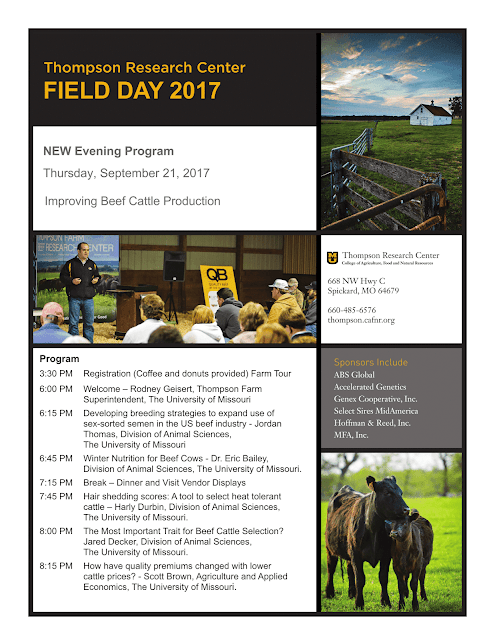
The Thompson Research Field Day will be Thursday, September 21, 2017. This year we will be having an evening program, hopefully to better accommodate more people's schedules. See the flyer below for program details. Dinner will be provided.

Angus Single-Step Has Launch Date

Angus Genetics Inc will switch to single-step genomic prediction on July 7th. Since 2010 they have been using multi-step genomic prediction. In multi-step, genomic predictions are treated as correlated traits to produce GE-EPDs. In single-step, all genomic, pedigree, and performance data is analyzed in one model. The key to calculating EPDs is measuring genetic similarity. Traditional EPDs used pedigree data to estimate genetic similarity. In single-step, genomic data more accurately measures relatedness, i.e. genetic similarity. The pedigree and genomic relationship measures are combined. Since November, AGI has evaluated multi-step vs single-step. They have seen very similar accuracies between the two methods. But, single-step tends to have slightly higher accuracies. Further, there are several advantages to single-step. These advantages include removing the need to recalibrate and using all of the data simultaneously. Watch for further information from Angus about the switch t...

Producers invited to participate in research to identify cows that match their environment

Image
Researchers to use genomics to better understand hair shedding *Update 28 June 2016: We have recruited all of the animals that we have funds to genotype. We are still happy to receive hair shedding scores, especially for animals with GE-EPDs. But, we will not be collecting any more DNA samples to genotype additional animals. It’s time to pick a new AI sire. You identify a promising sire, but then you are left with a question. Will his daughters work in your environment and the environment of your customers? A new research project lead by researchers at the University of Missouri, Texas A&M, University of Arkansas and DeltaG will use existing data to look for genetic adaptation to regional beef production environments. Much of this research will look for gene-by-environment interactions. When gene-by-environment interactions exist, some genetic variants have large effects in some environments and small effects in others. This leads to cattle that perform poorly i...

Angus Announces Routine Calibration of GE-EPDs

Image
Genomic-enhanced selection tools to undergo scheduled upgrade American Angus Association® and Angus Genetics Inc. (AGI), the organization’s genetic services subsidiary, will soon release newly calibrated genomic-enhanced expected progeny differences (GE-EPDs). On March 21, AGI announced plans to release the latest calibration of its genomic-enhanced selection tools in mid-April. The process is the fifth of its kind since introducing GE-EPDs in 2010, and further refines how DNA test results are incorporated with pedigree, performance measures and progeny data into the selection tools released through the Association’s weekly National Cattle Evaluation (NCE). AGI President Dan Moser says the extensive process of calibrating GE-EPDs results in further accuracy on more animals in the Association’s growing database, but with generally less incremental change with each consecutive calibration. “This latest calibration represents a fine-tuning of the genomic-enhanced EPDs provide...

Now HIRING! Looking for passionate graduate students and post doctoral fellows

My group is currently recruiting people to fill two graduate student positions. We will also be recruiting a researcher to fill a postdoctoral position in the coming year. We are looking for candidates who are passionate about genetics, genomics, and research. Ideal candidates are creative, hard working (while maintaining a work/life balance), and self starters. Our group is strictly computational, so candidates should enjoy working on computers and analyzing data. Candidates should be willing to learn programming (typically in R or Python), or already have some programming experience. We will soon have access to over 200,000 genotyped beef cattle with phenotypes and breeding values. We also have access to whole genome sequencing data from over 2,000 cattle. So, if you like working with lots of data, come join us! Our group uses population genomics to better understand the  history of cattle breeds and to inform future selection decisions. We are interested in local genetic ada...

Angus Genetics Inc. Updates to EPD/Pedigree Lookup

Based on input and requests from breeders, we’ve been working on some updates to the information displayed on the Animal Search feature on Angus.org. These new features went live this morning [10 November 2015] , and I want to take a minute to highlight and explain these enhancements. Genomic Progeny  EPD percentile ranks Progeny  For complete post, please visit Angus Genetics Inc blog , and read the post by Dr. Tonya Amen. Decker's Take Home: I always love to see breed associations changing and innovating. I think these changes will allow producers to more quickly evaluate an animal's genetic merit. Plus, I'm sure breeders appreciate AGI responding to requests. Loading...

2015 NBCEC Brown Bagger Series Kicks Off

Image
by Jeffrey Beall The 2015 National Beef Cattle Evaluation Consortium Brown Bagger series kicked off today. The Brown Bagger is a webinar discussing beef cattle genetics every Wednesday in October at 12:00 Central time. While we've already missed today's webinar, no fear there are more great presentations coming up. Plus, recordings of today's webinar will be available online in the coming weeks. The theme for this year's series is "Advancing genetic selection in beef cattle: Improving current tools and developing new ones." The following presentations are scheduled: Oct 7 Advancements in National Cattle Evaluation Strategies Host, Dr. Matt Spangler Latest changes to national cattle evaluation systems—Dr. Bob Weaber, Kansas State University Across Breed EPD and multi-breed genetic evaluation developments—Dr. Larry Kuehn, USDA-ARS-US-Meat Animal Research Center Oct 14 Beef Cattle Fertility Project and Sequencing Effort Update Host, Dr. Darrh...

Missouri Red Angus Association Creates Centralized Bull Test

Image
The Missouri Red Angus Association invites all Red Angus breeders large and small, near and far, to participate in a newly established bull test. Come and join the new era of the Missouri Red Angus Association. Missouri Red Angus Association’s (MORAA) Board of Directors has been evaluating the past methodology for marketing bulls at the April MORAA sale in Springfield. Based on their evaluation and consistent member feedback that the old program was inadequate, a new program has been launched. The board believes this will be an excellent marketing opportunity for Red Angus genetics. For cattlemen who have an interest in participating in the project, the test is now accepting entries with receiving dates from Oct. 1–15 for bulls born January, February and March of 2015. Entry-Consignment Fee: $200 per bull Paid at entry to the selected developer Consignor must be a current Missouri Red Angus member Approved Test Facilities & Developers: Green Springs Bull Test - Nev...

Thompson Research Center Field Day: September 15, 2015

Image
The Thompson Research Center Field Day will be held on Tuesday September 15, 2015 at the research center in Spickard. I will be discussing the use of genomics predictions in registered and commercial heifers. In addition to my talk and demonstration, there will be information on reproduction, nutrition and forages, antibiotic labeling, economics, and timber sales. In the survey below, let me know what topics or questions you would like addressed in my presentation. For those of you in Northwest Missouri, I would love to see you there. Loading...

eBEEF.org launched at BIF

Image
A new website dedicated to beef cattle genetics has been launched at the 2015 Beef Improvement Federation Conference. eBEEF.org is part of the national eXtension program with the goal of being a one-stop site for beef cattle genetics and genomics information. Beef cattle specialists from six land grant institutions have joined forces to provide educational materials that are pertinent to today’s beef cattle producers, without searching multiple sites or filtering through countless hits on a search. The site contains factsheets , short frequently asked question (FAQ) video clips, relevant conference recordings and webinars, a blog and links to other useful beef sites. One of the developers of the new site, Dr. Darrh Bullock at the University of Kentucky said “Often beef producers get frustrated when they search for information online and get information overload. We wanted to develop a user friendly site that provides information in a concise, understandable way without having ...