Posts

Showing posts with the label technology

Featured Post

Dr. Jamie Courter is your Mizzou Beef Genetics Extension Specialist

Image
By Jared E. Decker Many of you have probably noticed that things have been a lot less active on the A Steak in Genomics™   blog, but you probably haven't known why. In January 2021, I was named the Wurdack Chair in Animal Genomics at Mizzou, and I now focus on research, with a little bit of teaching. I no longer have an extension appointment. But, with exciting news, the blog is about to become a lot more active! Jamie Courter began as the new MU Extension state beef genetics specialist in the Division of Animal Sciences on September 1, 2023. I have known Jamie for several years, meeting her at BIF when she was a Masters student. I have been impressed by Jamie in my interactions with her since that time.  Dr. Courter and I have been working closely together the last 6 weeks, and I am excited to work together to serve the beef industry for years to come! Jamie holds a bachelor’s degree in animal science from North Carolina State University and earned a master's degree in animal...

Show-Me Ag: Beef Genetics and the Environment

Image
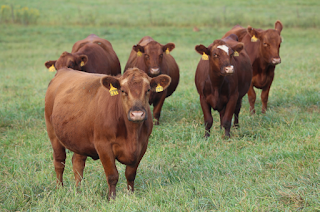
Are cattle responsible for 51% of greenhouse gas emissions? How can technology help? Head over to the Show-Me Ag website to see Jared Decker discuss beef cattle, the environment and genetics. https://www.kmos.org/ShowMeAg/ Episode from December 12, 2019 (2019/12/12, titled "Cattle Genetics").

2019 National Beef Essay Contest: “What does it mean to be a beef breeder in the 21st century?”

Image
Youth interested in the beef industry are encouraged to compete in a national essay contest. Essays should respond to the prompt “What does it mean to be a beef breeder in the 21st century?” The winning essay will be published in one of  BEEF  magazine’s online newsletters (e.g.  BEEF  Daily or  BEEF  Cow-Calf Weekly). The 2nd through 5th place essays will be published on  A Steak in Genomics  blog. We will award $500 for first, $300 for second, and $200 for third place in the contest. New this year, we will have two age divisions, "13 and Younger" and "14 to 19".  Essays will be judged by beef genetics extension specialists, breed association staff, and trade publication staff. Essays will be judged on their ability to encourage best practices and technology adoption by describing: Trust and effectiveness of beef breeding best practices and technologies. Simplicity of using technology. The profit and sustainability outcom...

2018 ReproGene Sessions Announced

Written by Duane Dailey Beef-cow herd owners will learn new ways to raise better calves at three University of Missouri meetings in March. The sessions lead producers from proven breeding to new uses of DNA. MU Extension animal scientists David Patterson and Jared Decker will lead the ReproGene Meetings. Management of fixed-time artificial insemination allows more live calves and more uniform calf crops. New DNA tools make rapid advances in beef quality. Genomics allow breeders to predict traits of the next generation. Traditionally, breeders use expected progeny differences (EPDs). Now, new EPDs add DNA data. Pedigrees and production testing are still used; however, genetically-enhanced EPDs give more accuracy. A simple DNA test with blood or hair samples replaces years of production testing. With GE-EPDs, the added DNA speeds improving traits, whether for maternal or meat market ends. Recent high premiums at packing plants signal demand for more high-qual...

TRC Field Day: Sex-Sorted Semen

Image
Jordan Thomas, a PhD candidate in David Patterson's group, presented on the use of sex-sorted semen in the beef industry at the MU College of Agriculture, Food and Natural Resources Thompson Research Center Field Day. Loading...

Brangus Journal: Gene Editing: What Beef Producers Need to Know

Head over to the Brangus website to read my article, " Gene Editing: What Beef Producers Need to Know. " For more information, see Alison Van Eenennaam's blog post titled " FDA seeks public comments on regulation of genetically altered animals ." Importantly, the open period for commenting on the draft regulations has been extended until June 19th. Draft guidance:  https://www.fda.gov/downloads/AnimalVeterinary/GuidanceComplianceEnforcement/GuidanceforIndustry/UCM113903.pdf Commenting Website: https://www.regulations.gov/document?D=FDA-2008-D-0394-0279 ). Loading...

2017 Cattle Raisers Convention: Making the Cow Herd More Efficient by 2037

Dr. Clay Mathias King Ranch Institute After adjusting for inflation, there was an 18% increase in calf value from 1990 to 2015. The big cost categories are Depreciation, Feed, and Labor. The drivers of these are corn, oil, ag land and minimum wage. Corn cost increased 24%. Oil increased 284%. Ag land increased by 134%. Labor only increased by 9%. "Like calf prices, all of these increased more than inflation." Mathias said. We have seen a 30 to 50 lb increase in weaning weight over the past 20 years in the seedstock sector. We have data-driven tools for selection decisions such as genomic-enhanced EPDs. In Texas, New Mexico, and Oklahoma: Pregnancy rate from 1993 to 1995 was 89%. In 2013 to 2015 it was 90%. Weaning rate from 1993 to 1995 was 84%. In 2013 to 2015 it was 84%. Weaning weight from 1993 to 1995 was 525 lbs. In 2013 to 2015 it was 525 lbs. Pounds of calf weaned/cow exposed was 439 lbs. It was 438 lbs. in 2013 to 2015. Identical trends are see...

Red Angus DNA Scores Align with Carcass Results

Image
Denton, Texas — Cattlemen and women frequently ask if DNA scores are truly predictive of phenotypic results. A recent study completed by the Red Angus Association gathered DNA data on a set of Red Angus calves and followed the cattle through harvest, collecting phenotypic data. The results illustrated the Igenity® DNA scores accurately predicted carcass weight, marbling score and overall carcass value. The cattle were raised and owned by Bob and Elaine Yackley of Onida, South Dakota, and fed at a custom feed yard. A total of 91 head of 2015-born steers comprised the group that was DNA tested with Igenity Silver and followed through harvest to obtain carcass data on each individual animal. The top 25 head with the highest DNA scores for Average Daily Gain (ADG) and marbling were compared to the bottom 25 head, which exhibited the lowest combined DNA scores for the same two traits. Summarized results for the two groups are shown in the table. This comparative analysis reveals that ...

Genomic Prediction Patented???

Image
Hat tip to Dr. John Cole, USDA, and Jesse Hoff for bringing this to my attention on Twitter . I need to make an important point: I am not a patent lawyer. I do not have a deep understanding of patent law and nothing in this post should be considered legal advice or council. On November 8, 2016 Canada issued a patent to Ben Hayes and Michael Goddard for genomic prediction. Genomic prediction is estimating an animal's breeding value (i.e. genetic merit) using DNA variants. See the Canadian Intellectual Property Office website for more detailed information about the patent. Meuwissen, Hayes and Goddard first published their work on genomic prediction in 2001. Hayes and Goddard filed for a patent of the method on December 21, 2007 with the United States Patent and Trademark Office. About 23 days later, the Illumina BovineSNP50 Beadchip, a DNA test that can test 54,000 DNA variants quickly and cheaply for cattle, was released at the Plant and Animal Genome Conference. This 50K ...

ASA Fall Focus: Taking Technology Home to the Farm and Ranch

Image
Here are videos from the American Simmental Association's Facebook livestream of my presentation titled "Taking Technology Home to the Farm and Ranch." Tradition Intuition Legacy Seedstock Producers as Educators Decker's Rants EPDs and Environment  Q&A Loading...

BIF 2016: Using genomic tools in commercial beef cattle: taking heifer selection to the next level

Image
Tom Short Zoetis Can genetic information from a simple DNA sample allow us to reasonable accuracy of the females lifetime performance? We know that our national cow herd inventory decreased to a very low level in 2014. When we rebuilt the cow herd did we keep low quality heifers that should have never been cows? What type of genomic prediction should we be using to select commercial heifers? GeneMax Advantage was produced by a collaboration of Angus Genetics Inc, Certified Angus Beef, and Zoetis. It is applicable to beef females that are at least 75% Black Angus. These predictions are based on the Zoetis HD50K product for Angus. The correlations between the genomic predictions and the breeding value are all quite good, around 75%. The individual traits are combined into three indexes. These are a Cow Advantage Score, Feeder Advantage Score, and Total Advantage Score. The correlation between Total Advantage and the Cow and Feeder indexes are about 70%, but the correlation b...

BIF 2016: Can Beef Seedstock Producers Afford Genomics?

Breeding objectives indicate value of genomics for beef cattle Dr. Mike MacNeil DeltaG Is genomic testing a good value to seedstock producers? The answer to this question requires several different lines of thought. To answer this we need a system based approach. What makes up a genetic prediction? Information from relatives Molecular breeding value Correlated phenotypes Phenotype No individual animal in a genetic prediction ever has an accuracy of prediction of zero. The information from the calf's relatives brings in substantial amount of information. What are the advantageous of genomic prediction? 1) Increase accuracy of evaluation 2) More exciting is the opportunity to incorporate additional traits costly or difficult to measure measured late in life (after the time of selection decisions) sex-limited 3) Avoid prolonged generation intervals. For many selection decisions in beef cattle, we make many selection decisions around a year of age. 4)...

The IGS Implementation of BOLT

Bruce Golden Theta Solutions Over the last 50 years we have had evolution of the statistical methods used to calculate genetic predictions, EPDs, for livestock. What drove the evolution of these methods? Knowledge of statistical models? New methods? Data? Enabling computer technology? Golden states that he believes the drive for better models has been a desire to increase the accuracy of prediction. Golden and Garrick had written grants to write genetic prediction software in the past. This avenue appears to have dried up, so they decided to start a company, Theta Solutions, in order to fund the development of genetic prediction. The latest genetic prediction runs contained 46,000 animals with genomic data. Theta Solutions uses graphical processing units, originally built for video gaming, to have a high performance computer at a relatively low cost. The BOLT software focuses on custom turnkey analyses, once the system is set up all one needs to do is feed it data. Using non-G...

Hereford Education Forum: AHA Developments in National Cattle Evaluation

Dorian Garrick Iowa State University The Pre-Genomic Era In the Pan-American Evaluation there are four countries, US, Canada, Uruguay and Argentina. Agricultural Business Research Institute (ABRI) collects the pedigree and trait data. Then the Animal Genetics & Breeding Unit uses BREEDPLAN to estimate EPDs. To put the number of records turned in to the AHA data in context, we can compare them to other breeds. The 11 breed associations in International Genetic Solutions add 340,000 new animals in each of 2012 and 2013. AGI adds about 300,000 per year. Herefords add a little less than 100,000 animals per year. The Early-Genomic Era Cattle have 30 pairs of chromosomes. There are about 100 million base pairs per chromosome and about 2.6 billion base pairs in the entire DNA (genome). Most errors in chromosome replication are fixed. But, some slip through and are passed down through generations. The EPD of a bull is a sum of the average gene effects he carries. Until the g...

The Power of the Genome: Weighing Opportunities, Dangers and Responsibility

Image
Angus Convention 2015 Richard Resnick CEO of GenomeQuest One can not impede scientific progress. - Mahmoud Ahmadinejad   Resnick gave a series of examples of how genomics is changing society. Resnick put a nice spin on the typical sequencing cost figure . He overlays Illumina's ( $ILMN ) stock price on top of the figure. He went on to explain that the only real differences between humans, cattle, corn, and other species is the proteins they make. The amino acids, the building block of proteins, are actually the same between species. Resnick used cystic fibrosis as an example of a disease in which genetics has been very important. One DNA variant that causes the disease is called ΔF508. When a person has this variant, the gene produces the protein, but a check and balance in the cell recognizes the protein as not correct and destroys it. A different variant, G551D, is not so severe that the protein is destroyed, but the protein does not function properly. A drug call...

What have we learned from sequencing efforts to date?

Image
And where are we going next? Data via  http://www.genome.gov/sequencingcosts/ . Code for generating the plot at  https://missouri.box.com/SequencingCost . This graph never ceases to amaze me. On the horizontal axis we have dates from September 2001 to July 2015. On the vertical axis we have the cost to sequence a million base pairs of DNA, with the axis having a logarithmic scale  (each tick mark is multiplied by 10, e.g. change from 10 to 100 to 1000). The blue line describes what is called Moore's Law  which describes the increase in purchasing power as computer costs come down. The rate of improvement in DNA sequencing easily outpaces the improvement in computing. Since September 2001, the price of DNA sequencing has dropped 6 orders of magnitude  from $5,292.39 to $0.015. From more than $5,000 to less than 2 cents!!! Same data as above by with the vertical cost axis  on a normal scale, not logarithmic. What caused the drop in sequencing f...

Thompson Research Center Field Day: September 15, 2015

Image
The Thompson Research Center Field Day will be held on Tuesday September 15, 2015 at the research center in Spickard. I will be discussing the use of genomics predictions in registered and commercial heifers. In addition to my talk and demonstration, there will be information on reproduction, nutrition and forages, antibiotic labeling, economics, and timber sales. In the survey below, let me know what topics or questions you would like addressed in my presentation. For those of you in Northwest Missouri, I would love to see you there. Loading...

Sustainability: What Does the Data Say About the Beef Industry

Dr. Kim Stackhouse-Lawson National Cattlemen's Beef Association Sustainability is now seen as responsibility. Sustainability is now continuous improvement. Sustainability is about feeding people; doing more with less. Zero impact is not possible. Start the conversation with this point. Over the last 6 years, we have improved sustainability by 5%. How is this possible when we weren't even thinking about sustainability 6 years ago? Any technology improvement we have implemented has improved sustainability. Stackhouse-Lawson's father-in-law thought her sustainability research project was a complete waste of Beef checkoff dollars to define a word, sustainability, that outsiders created. When she thanked him for helping her project, he was completely taken aback. She then explained that the new sprinkler system he had installed improved the sustainability of his operation. To meet the growing demand for beef by meeting environmental, economic and social concerns. Fo...