Posts

Showing posts with the label breed association

Featured Post

Dr. Jamie Courter is your Mizzou Beef Genetics Extension Specialist

Image
By Jared E. Decker Many of you have probably noticed that things have been a lot less active on the A Steak in Genomics™   blog, but you probably haven't known why. In January 2021, I was named the Wurdack Chair in Animal Genomics at Mizzou, and I now focus on research, with a little bit of teaching. I no longer have an extension appointment. But, with exciting news, the blog is about to become a lot more active! Jamie Courter began as the new MU Extension state beef genetics specialist in the Division of Animal Sciences on September 1, 2023. I have known Jamie for several years, meeting her at BIF when she was a Masters student. I have been impressed by Jamie in my interactions with her since that time.  Dr. Courter and I have been working closely together the last 6 weeks, and I am excited to work together to serve the beef industry for years to come! Jamie holds a bachelor’s degree in animal science from North Carolina State University and earned a master's degree in animal...

Herefords in the Cove: Measure What is Important to You

Image
 As I no longer have an extension appointment, my presentations at producer meetings have become much less frequent. I did get the opportunity to present at Herefords at the Cove event put on by the Georgia Hereford Association. This is a continuation of the Herefords on the Mountain event started by Tommy Coley. Here is a link to my slides. Decker_HerefordsCove_2022.pptx As I was driving home from Junior National Hereford Expo, a thought popped into my head. I like Love's gas stations. Part of the reason I like them, is they consistently have clean bathrooms. And why do they have clean bathrooms? Because they measure it! As cattle breeders, we can take a lesson from this. We need to make sure we are measuring what is important to us and our customers.

Brangus Journal: Hair Shedding Scores in Brangus Cattle

 You can visit the Brangus Journal to read an article Harly Durbin and Jared Decker wrote about hair shedding scores in Brangus cattle.  https://issuu.com/gobrangus/docs/2021_april_brangus_journal-compressed_2/26

EPDs and Genomics: A Conversation with the American Angus Association Board

Image
At the National Western Stock Show, I had a great discussion with the American Angus Association board and members. Angus Media put together a nice summary of that presentation.

Angus TV: Hair Shedding Research EPD Developed

Image
We will have a scientific article describing the hair shedding research soon. Work was completed by Harly Durbin during her time at Angus Genetics Inc. as an intern.

Red Angus Seeking Input on Selection Indexes

The Red Angus Association of America is seeking feedback on their economic selection indexes. Producers can provide feedback at this link: https://www.surveygizmo.com/s3/5183855/RedAngusAssociation?fbclid=IwAR3qskT1DJ6UMbSIS2R3ul316FQ6L_k-Gt_DYDq8wB8omLQOgkG1yCuAGbM To be frank, I am conflicted by this process. On one hand, I think it is important to have translational research be a collaborative process. Further, users are more likely to trust and use a technology if they were involved in its creation. However, often times, optimal selection decisions are counterintuitive  (need to write a blog post on this). I feel strongly that selection decisions are best made when driven by data, and that includes design of selection tools. American Angus Association went through a similar process, and it is my understanding they used the survey data to weight economic importance of traits that are hard to pin down, such as claw set and docility. Traits that are economically important,...

Selection for Improved Carcass in Red Angus

Image
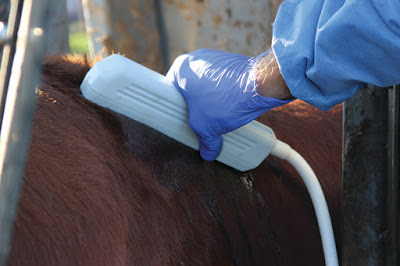
by Ryan Boldt, Director of Breed Improvement, RAAA Selection for carcass trait performance is important to keep in mind when making bull-purchasing decisions. Most carcass traits are moderately heritable in nature. In seedstock animals, the best method to collect information about carcass-trait performance is through the use of ultrasound imagining. Generally, ultrasound information is collected on seedstock animals at a year of age. When an ultrasound is collected, up to four measurements are taken. The most common measurements recorded include intramuscular fat, backfat, and rib eye area which serves as the best indicators for carcass marbling score, carcass back fat and carcass ribeye area. The ultrasound information is collected via a probe that emits high-frequency sound waves. The probe is placed on the animals back and an image is created that shows the difference between different tissues under the animal’s hide. These images are captured by a certified ultrasound techn...

Neogen partners with IGS to enhance Igenity® Beef Profile

Neogen Corporation announced September 19th, 2019 that it has entered into a collaboration with International Genetic Solutions (IGS). The effort is focused on heightening genomic impact in the IGS platform, the only major multibreed beef genetic evaluation available, and at the same time greatly enhancing the research and development necessary to continue to improve Neogen’s Igenity ® Beef Profile. The Igenity Beef Profile is a leading global genetic testing product that helps producers of both straightbred and crossbred beef commercial cattle select their best animals for breeding programs. IGS delivers the most credible, objectively described, user-friendly and science-based genetic predictions to enhance the profitability of beef cattle producers who look to leverage the full power of expected progeny differences (EPDs). “As part of this partnership, Neogen will benefit from access to information that will improve the Igenity Beef Profile, and IGS will endorse and promote ...

Benefits of a Shortened Breeding Season

Image
Reprinted from the American Red Angus Magazine. Written by Jaclyn N. Ketchum, Cliff Lamb, and Michael F. Smith, Division of Animal Sciences, University of Missouri, and Department of Animal Science, Texas A&M University Efficiency, sustainability, productivity and profitability – these words are used in conversations around the world including among cattlemen. How do cattlemen assimilate these goals into their herd? One way is by implementing a defined breeding season. “Heifers that conceive earlier in the breeding season will calve earlier in the calving season and have a longer interval to rebreeding. Calves born earlier in the calving season will also be older and heavier at weaning,” stated Robert Cushman of U.S. Meat Animal Research Center. He added, “Heifers that calved early in the calving season with their first calf had increased longevity and kilograms weaned, compared with heifers that calved later in the calving season.” Increased longevity and he...

American Angus Association to Update $Value Indexes

Image
Updates are based on a major research effort and will be effective this June. The American Angus Association® Board of Directors approved changes to the $Value Indexes during the February board meeting Feb. 18-21, 2019. Updated $Value Indexes will be available this June, and changes include revisions to Beef Value ($B), updating the Weaned Calf Value ($W) model to the new Maternal Value ($Maternal) and rounding all $Values to whole dollars to eliminate decimals. Quality Grade ($QG) and Yield Grade ($YG) will be removed because $QG is redundant to the Marbling EPD, and $YG is redundant to Fat and REA EPDs. In addition, a balanced index will be implemented June 2020 with a complete education plan to be executed with the membership and industry to take place over the next 15 months. “Our current $Value Index models have served us well since 2004,” said Dan Moser, Angus Genetics Inc. president. “But since 2004, technology has improved, and new EPDs have been created. So, an ex...

Show-Me-Select Board Approves Genomic Testing Requirement for Natural Service Sires

Image
All bulls purchased after February 1st, 2019 for use as natural service sires in the Show-Me-Select Replacement Heifer Program ™  must be DNA tested to have genomic-enhanced EPDs. All bulls used as natural service sires after February 1st, 2020 must have genomic-enhanced EPDs, regardless of when they were purchased. Seedstock producers classifying bulls as Show-Me-Select qualified in sale books must have genomic-enhanced EPDs on those lots. Bulls purchased prior to February 1st, 2019 will be grandfathered into the program, as is the common practice with all natural service sires. However, this grandfather grace period will end February 1st, 2020. At that time for a bull to qualify for use in the program, it must have genomic-enhanced EPDs. Why the change? The Show-Me-Select Replacement Heifer Program has the goal of producing premium heifers that perform predictably as 2 year olds. The program has a history of requiring Show-Me-Select producers to go beyond typical...

Angus Genetics Inc Releases Foot Score Research EPDs

Image
In January, Angus Genetics, Inc. (AGI) announced the release of research Claw Set and Foot Angle EPDs. The development of a research EPD is the second step towards a production EPD. This followed research presented in the summer of 2017 which found heritabilities of 0.34 for foot angle and 0.21 for claw set. Estimating heritability (portion of the trait influenced by genetics) is the first step towards a production EPD. This research also found a genetic correlation of 0.22 between the two traits, indicating that both traits need to be reported and analyzed. Stephen Miller, AGI Director of Genetic Research stated, "“Angus breeders have completed a tremendous amount of data reporting in such a short period of time; this is truly a testament to their commitment toward genetic progress. We are absolutely thrilled to begin the process of rolling this breakthrough out to the membership.” Kelli Retallick, AGI Director of Genetic Services cautioned, “Though we are getting closer ...

Breed composition: it’s like chocolates you can’t tell what’s inside just by looking at them

Image
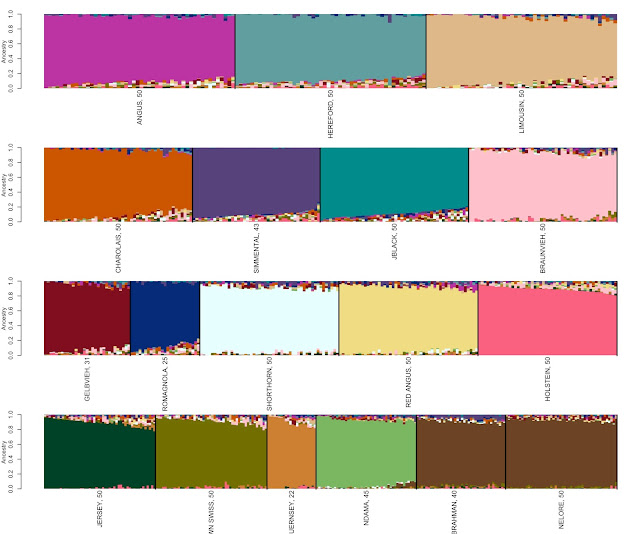
Written by  Tamar Crum, Jared E. Decker, Robert D. Schnabel, and Jeremy F. Taylor “My mom always said life was like a box of chocolates.   You never know what you’re gonna get.” – Forrest Gump You may be wondering how in the world does a box of chocolates relate to breed composition of livestock? Or, if you are anything like me, it’s where did I hide that Halloween chocolate, I need some! I think that there are two analogies between a box of chocolates and the breed composition of livestock.   First, we can pick out the white chocolates and may even be able to separate the milk chocolates from the dark chocolates.   This is similar to our ability to visually evaluate breed characteristics and sort livestock into different breed or subspecies ( Bos taurus or Bos indicus influenced) based on breed characteristics.   However, such visual evaluation of breed composition is not terribly accurate.   For example, biting into a piece of dark chocol...

AHA Educational Session 2017: Paving the Genetic Path

Dorian Garrick Theta Solutions LLC The Theta Solutions LLC is made up of Dr. Bruce Golden, Dr. Dorian Garrick, and Dr. Daniel Garrick. They have developed the BOLT software for genetic and genomic evaluations. The American Hereford Association formed an advisory committee to check the new genetic evaluation system. The advisory committee looked at the process during development. The advisory committee included: Joe Ellis Jack Holder Lee Haygood Paul Bennett Mitch Abrahamsen Suppose we had 100 progeny (i.e. offspring) on 1 bull. You might look at that bull and decide you like him or you don’t like him. But, that bull is just an envelop that carries genetic information. What the bull looks like really doesn’t matter, what matters is what his progeny look like. The way to look at the genetic value, or breeding value, of the bull is to look at his offspring. But, there are lots of environmental effects that influence the performance of the offspring. One example is the age ...

AHA Educational Session: Hereford Leading the Industry

Jack Ward AHA Executive Vice President Kevin Oschner was the consultant helping with the AHA Strategic Plan. Oschner interviewed: Hereford breeders Seedstock producers from other breeds Commercial cow-calf producers Bull stud and reproduction professional Extension service personnel Auctioneer Packers They also sent a survey to all AHA membership. They had 518 participants from 43 states. Oschner then organized the information. Webinars were then held with the board of directors. They then had a 2 and a half day session to create the strategic plan. They also brought in outside thought leaders, which included John Lundeen, NCBA Joe Pawlak, Technomics John Butler, Beef Marketing Group Mitch Abrahamsen, Ph.D., Recombinetics Clint Schwab, Ph.D., The Maschoff's Mitch Abrahamsen Recombinetics The consumer is interested in how their food is made. The consumer can use social media to reach through to the food provider (McDonalds, Subway, Walmart, etc.). The...

AHA Educational Session: Maximizing Profit

Trey Befort AHA Director of Commercial Programs Brent Lowderman Carthage Livestock, Inc. Case Gabel  Hereford Advantage Program is a genetic merit feeder cattle program which looks at the bull batteries going into commercial programs. A commercial producer using Hereford bulls sends in the registration numbers for their bull battery. The Hereford Advantage Program then shows, compared to breed average, where these bulls sit. This is used to market the calves. Lowderman In 2003, John Meents approached Lowderman about having a Hereford influenced cattle. They started with 150 head, and last year they had over 800. Calves need to have two rounds of shots. Needs to be castrated and dehorned. They then break the calves into lots based on 100 pounds increments to group them into similar lots (steers between 450 and 550 pound, between 550 and 650, etc.). Heifers are broken into lots by 75 pound breaks. The Hereford sale is within 1 to 3 dollars of the Angus ...

Calving Ease and the Law of Diminishing Returns

Image
By Darcy Vial USDA FSA Oregon via Wikimedia Commons Written by Tom Brink RAAA CEO Reprinted from the Red Angus eNews - October 4, 2017 Calving ease is especially important in first-calf females, and is therefore something we pay close attention to when breeding virgin heifers. In fact, calving ease considerations usually rank first on the list when selecting bulls to use on heifers.   Red Angus bulls often see service on heifers thus, mapping the relationship between calving ease EPDs (CED) and unassisted births is a worthwhile task. The better Red Angus breeders understand this relationship, the better selection and mating decisions they can make for themselves and their customers. The curved line shown in the chart below was statistically derived from tens of thousands of Red Angus calving records stored in the RAAA database. All of the calvings are from first parity females bred to bulls ranging from -8 to 20 for CED. This line captures the “average” or “t...