Posts

Featured Post

Dr. Jamie Courter is your Mizzou Beef Genetics Extension Specialist

Image
By Jared E. Decker Many of you have probably noticed that things have been a lot less active on the A Steak in Genomics™   blog, but you probably haven't known why. In January 2021, I was named the Wurdack Chair in Animal Genomics at Mizzou, and I now focus on research, with a little bit of teaching. I no longer have an extension appointment. But, with exciting news, the blog is about to become a lot more active! Jamie Courter began as the new MU Extension state beef genetics specialist in the Division of Animal Sciences on September 1, 2023. I have known Jamie for several years, meeting her at BIF when she was a Masters student. I have been impressed by Jamie in my interactions with her since that time.  Dr. Courter and I have been working closely together the last 6 weeks, and I am excited to work together to serve the beef industry for years to come! Jamie holds a bachelor’s degree in animal science from North Carolina State University and earned a master's degree in animal...

Video Chat: Mating Decisions based on Commercial Genomic Tests

EPDs 101: Use Information to Improve Your Herd

Image
Jared E. Decker Associate Professor, Division of Animal Sciences, University of Missouri Reprinted with permission from The Cattlemen and Santa Gertrudis Breeders International. Can we be frank for a minute? It is quite simple: EPDs work. When we use EPDs to make selection decisions (which bulls to buy, which females to keep and cull), the performance of our herd improves. Let’s discuss why EPDs work, how they can be used, and pitfalls to avoid. Defining EPD EPD stands for Expected Progeny Difference. “Expected” in this context is a loaded word. We use it here the way a statistician would use it. Expected means we are describing a prediction of the future. Expected also means we are discussing an average, not a single observation. What is the average that we are predicting with EPDs? We are predicting the average progeny, or the average of an animal’s calf crop. Finally, when we are discussing EPDs we are discussing differences. Either the difference between two animal...

American Angus Association to Update $Value Indexes

Image
Updates are based on a major research effort and will be effective this June. The American Angus Association® Board of Directors approved changes to the $Value Indexes during the February board meeting Feb. 18-21, 2019. Updated $Value Indexes will be available this June, and changes include revisions to Beef Value ($B), updating the Weaned Calf Value ($W) model to the new Maternal Value ($Maternal) and rounding all $Values to whole dollars to eliminate decimals. Quality Grade ($QG) and Yield Grade ($YG) will be removed because $QG is redundant to the Marbling EPD, and $YG is redundant to Fat and REA EPDs. In addition, a balanced index will be implemented June 2020 with a complete education plan to be executed with the membership and industry to take place over the next 15 months. “Our current $Value Index models have served us well since 2004,” said Dan Moser, Angus Genetics Inc. president. “But since 2004, technology has improved, and new EPDs have been created. So, an ex...

Bob Hough Comments on Changes at Breed Associations

Bob Hough recently posted the following comment on Facebook (posted with his permission): Early in my career at a breed association, the much beloved American Angus breed executive told me that the secret to success running a breed association was to have a top junior program, keep the books straight, and make sure the numbers (EPDs) don't change. This philosophy meant Angus valued stability in their genetic predictions over keeping them up-to-date with the latest science. The Angus Association also marketed extremely effectively the infallibility of their EPDs because of the size of their database. I will start with the later. Yes, a database needs certain critical mass to make sure the animals are tied, but that can be achieved in a modest size database. After that, data quality far and away outweighs data quantity in assuring the most precise and reliable EPDs possible. On the former point, Angus breeders are simply not use to change. This is not the case in most breed associ...

EPDs and Reasonable Expectations in Commercial Crossbred Operations

Image
Reprinted courtesy of ARSBC Newsroom Some people just don’t trust EPDs. The acronym EPD stands for “expected progeny difference” — a numerical value that represents a prediction of the average performance, relative to a specific trait, among the progeny of a breeding animal. To aid genetic selection, EPDs are used to compare the expected performance of one sire’s calves with those of another sire’s. “But some people are suspicious. They think someone is pulling strings to manipulate the numbers,” lamented animal geneticist Jared Decker while addressing a New Mexico gathering of cattle folk. “But EPDs work. They absolutely work.” A researcher and assistant professor at the University of Missouri, Decker returned to his native New Mexico to speak during the Applied Reproductive Strategies in Beef Cattle Workshop hosted Aug. 29-30 in Ruidoso. He talked about the value of using EPDs to achieve genetic improvement over the long haul. “EPDs work. They absolutely work,” said Jared D...

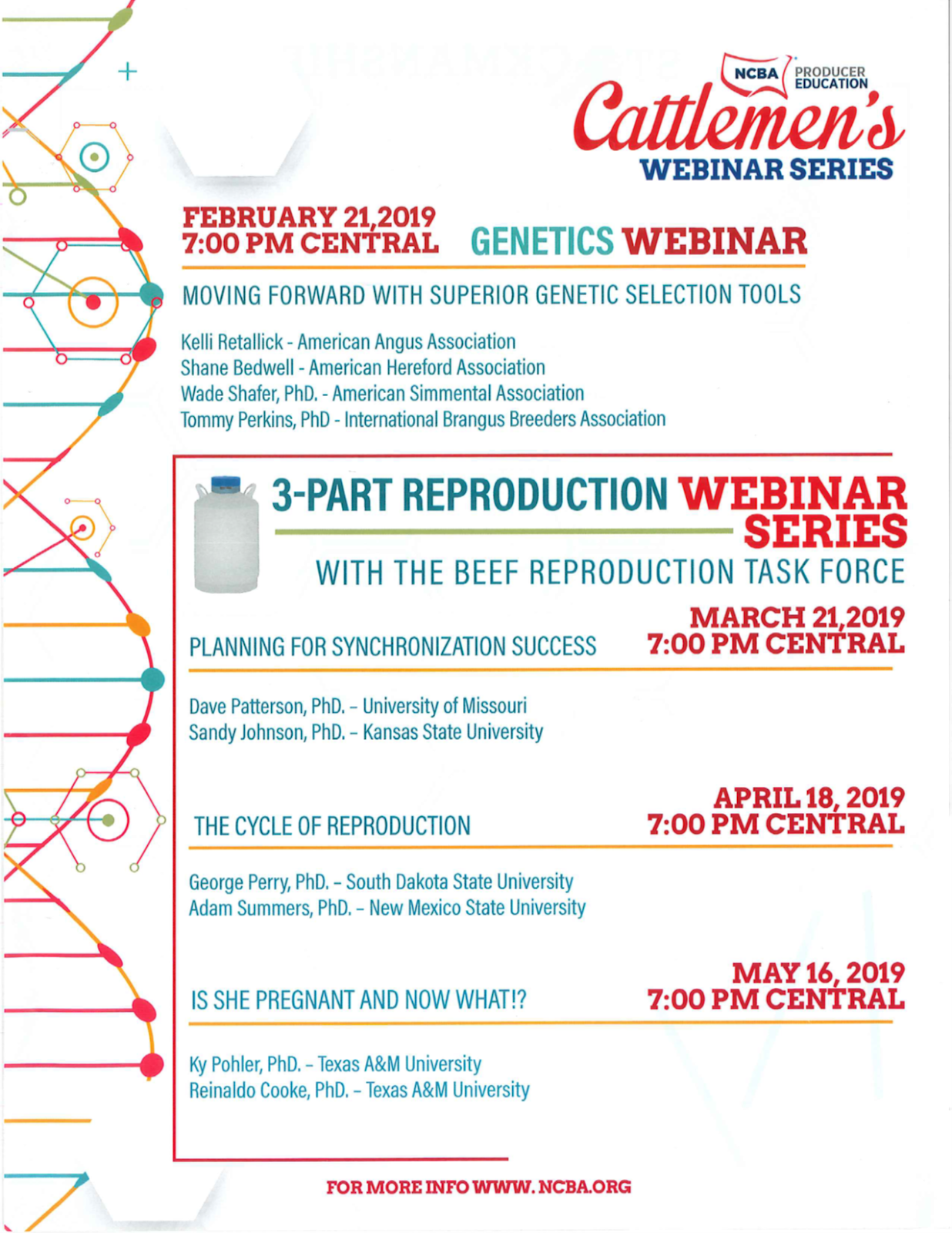
2019 NCBA Cattlemen's Webinar Series Announced

Image
Visit the NCBA Producer Education website to learn more.

CIC 2019: Unraveling the Secrets of the Rumen

Image
Tim McAllister AAFC Lethridge Research & Development Centre Microbes are part of the natural world, they occupy all parts of the world from deep sea vents, skin, digestive tract, and our food. The rumen is one of the most microbe rich environments in the world. We use fistulated animals to have a window into the rumen microbiome. Rather than looking at the bacteria that come out of the digestive tract, we can directly sample the rumen. The microbes in cattle rumens can even digest cotton shirts! In cattle, the majority of digestion happens in the rumen by the microbes. So, most of the time when we are feeding our cows, we are really feeding the microbes. Cows eat 2 to 20 kg of dry matter, 20 to 80 liters of water, and 50 to 150 liters of saliva. The microbes produce 2 to 6 kilograms of volatile fatty acids (VFA). The rumen also produces 0.75 to 2 kilograms of bacteria that go into the digestive system and can be digested. In a roughage diet, 65% of VFA is acetate. Cattl...